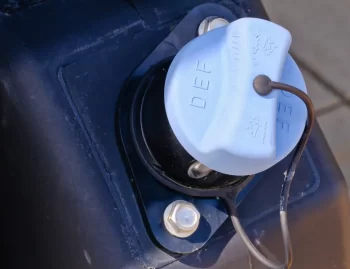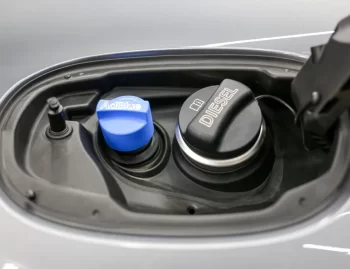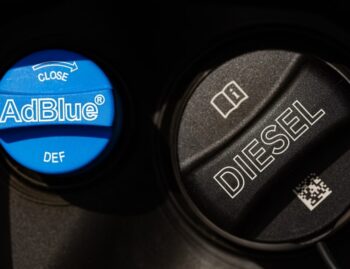
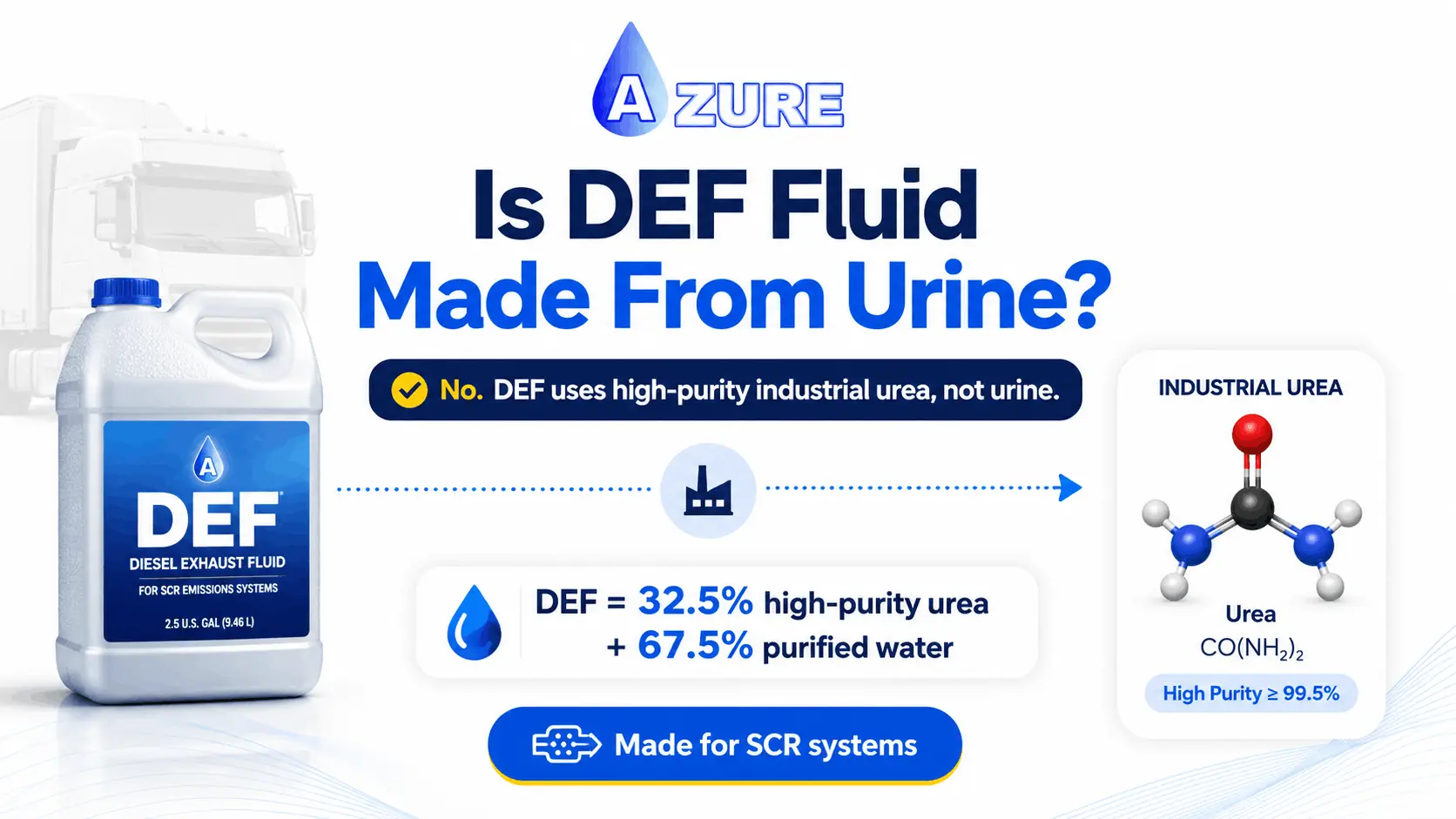
No. DEF fluid is not made from urine.
The misconception exists because Diesel Exhaust Fluid contains urea, and urea is also naturally present in human and animal urine. But sharing one chemical compound does not make two substances interchangeable.
Commercial Diesel Exhaust Fluid, commonly called DEF or AUS 32, is manufactured from 32.5% technically pure, industrially produced urea and 67.5% purified water. The International Organization for Standardization specifically defines AUS 32 as a solution made with technically pure urea that is industrially produced and tightly controlled for contaminants.
Urine, by contrast, is a biological waste fluid containing water, urea, salts, minerals, creatinine, and many other compounds that do not belong in a diesel emissions system.
So if you have heard that DEF is "basically urine," there is a small kernel of chemistry behind the myth, but the conclusion is wrong.
DEF contains urea. DEF is not urine.
The urea used in DEF is manufactured industrially to meet strict purity requirements.
For a broader introduction to the fluid itself, Azure Chemical's Diesel Exhaust Fluid guide explains its composition, applications, storage, and commercial supply options.
Contents
- 1 Why Do People Think DEF Is Made From Urine?
- 2 What Is DEF Actually Made From?
- 3 Where Does the Urea in DEF Come From?
- 4 DEF vs. Urine: Why They Are Not Interchangeable
- 5 What Would Happen If You Put Urine in a DEF Tank?
- 6 Can You Make DEF From Fertilizer-Grade Urea Instead?
- 7 How Does the Urea in DEF Actually Clean Diesel Exhaust?
- 8 Why DEF Purity Matters More Than Most Drivers Realize
- 9 How Can You Tell Whether DEF Is Legitimate?
- 10 Common DEF Myths, Corrected
- 11 What Should You Do If the Wrong Fluid Enters the DEF Tank?
- 12 Why the "DEF Is Urine" Myth Matters for Fleets
- 13 Frequently Asked Questions
- 13.1 Is DEF Fluid Made From Urine?
- 13.2 Is Urea the Same Thing as Urine?
- 13.3 What Percentage of DEF Is Urea?
- 13.4 What Is the Rest of DEF Made From?
- 13.5 Is the Urea in DEF Synthetic?
- 13.6 Can You Pee Into a DEF Tank in an Emergency?
- 13.7 Can I Make My Own DEF?
- 13.8 Is Fertilizer Urea the Same as DEF Urea?
- 13.9 Does DEF Go Into the Engine?
- 13.10 Why Does DEF Smell Slightly Like Ammonia?
- 14 The Bottom Line: Is DEF Fluid Made From Urine?
Why Do People Think DEF Is Made From Urine?
The confusion largely comes from the word urea.
Urea is a chemical compound with the formula:
CO(NH₂)₂
The human body produces urea while metabolizing proteins. The kidneys remove it from the bloodstream, after which it becomes one of many substances present in urine.
But urea is not synonymous with urine.
Think of it this way: sodium chloride exists in seawater, but a container of purified sodium chloride is not seawater. In the same way, chemically manufactured high-purity urea is not urine simply because urine naturally contains some urea.
Urea Is a Chemical Compound, Not a Bodily Fluid
Urea itself is a defined chemical compound used across multiple industries, including:
- agriculture
- chemical manufacturing
- resins
- pharmaceuticals
- cosmetics
- diesel emissions control
The urea used for DEF applications must satisfy significantly tighter purity requirements than simply "containing urea."
Azure explores the compound in greater depth in its guide to what urea in DEF actually is.
What Is DEF Actually Made From?
Diesel Exhaust Fluid has a deliberately simple formulation:
| Component | DEF Composition | Purpose |
| Technically pure urea | 32.5% | Provides the chemical precursor used to generate ammonia |
| Purified water | 67.5% | Carries the urea and enables controlled DEF dosing |
The American Petroleum Institute describes DEF as a 32.5% solution of technically pure urea in purified water. API also notes that DEF purity is important for protecting the vehicle's emissions-control system.
ISO 22241 goes further by defining technically pure urea as an industrially produced grade of urea that is tightly controlled for compounds and contaminants that could interfere with SCR operation.
Why Exactly 32.5% Urea?
The concentration is not a rough recipe that manufacturers can adjust at will.
AUS 32 is standardized at 32.5% urea by mass for use in diesel Selective Catalytic Reduction systems. ISO 22241 establishes the quality characteristics required for this NOx-reduction agent.
This is one reason urine could never serve as an acceptable substitute. Even before considering contamination, its chemistry and urea concentration do not satisfy the specification required by an SCR system.
Where Does the Urea in DEF Come From?
This is where the original misconception becomes easiest to resolve.
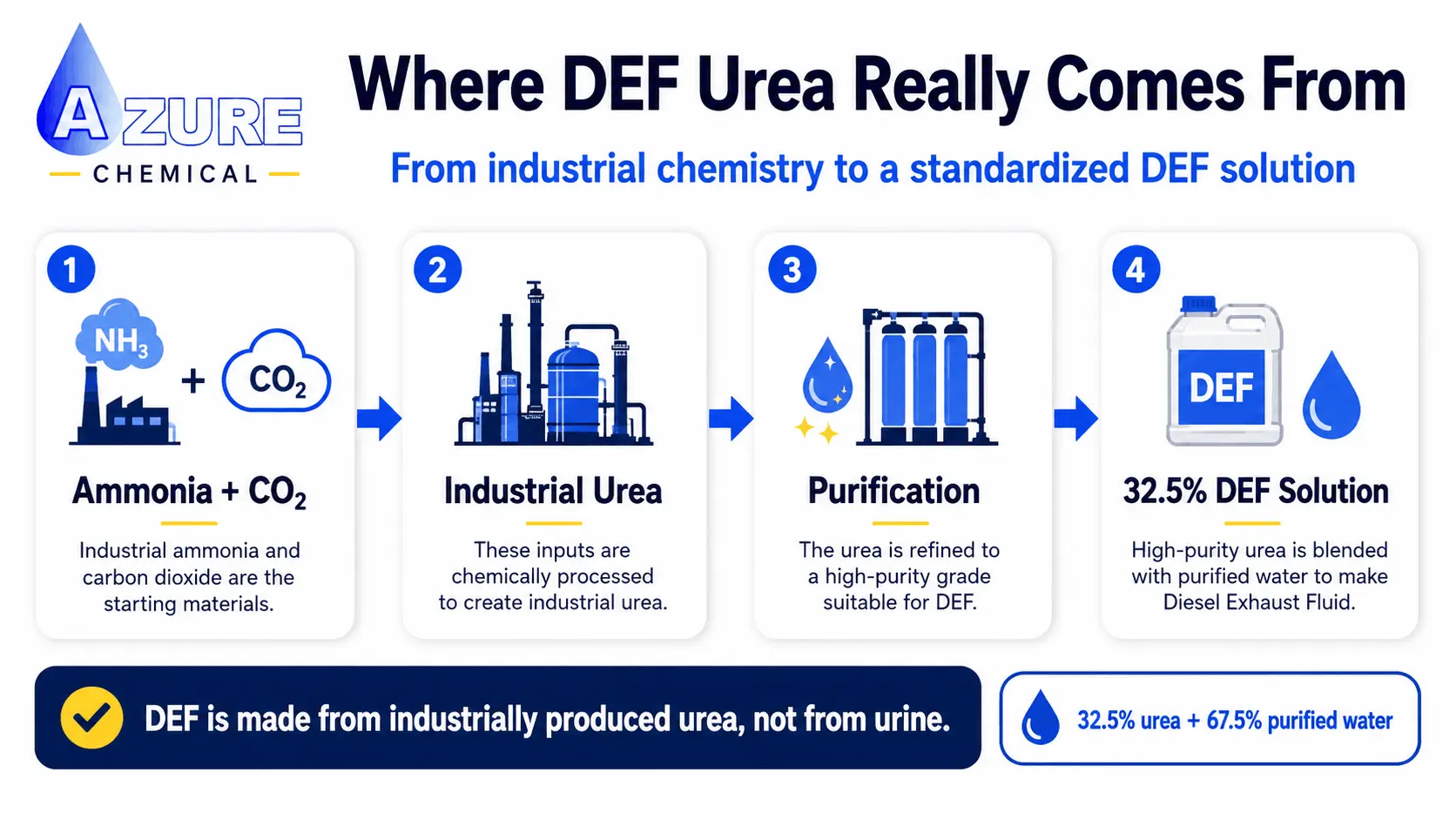
The urea used for Diesel Exhaust Fluid is industrially synthesized, not collected from humans or animals.
Commercial urea production generally starts with:
Ammonia (NH₃) + Carbon Dioxide (CO₂)
The process first forms ammonium carbamate, which is then converted into urea and water.
A simplified overall representation is:
2NH₃ + CO₂ → CO(NH₂)₂ + H₂O
The U.S. Environmental Protection Agency describes industrial urea production as reacting carbon dioxide with ammonia, forming ammonium carbamate and subsequently dehydrating it to produce urea.
That distinction matters.
DEF manufacturers do not extract urea from urine. Instead, they source or produce a controlled technical-grade urea suitable for the stringent requirements of diesel aftertreatment systems.
For readers who want the manufacturing process in greater detail, Azure already has a dedicated guide explaining what urea in DEF is made from.
DEF vs. Urine: Why They Are Not Interchangeable
This comparison is more useful than simply saying "DEF isn't pee."
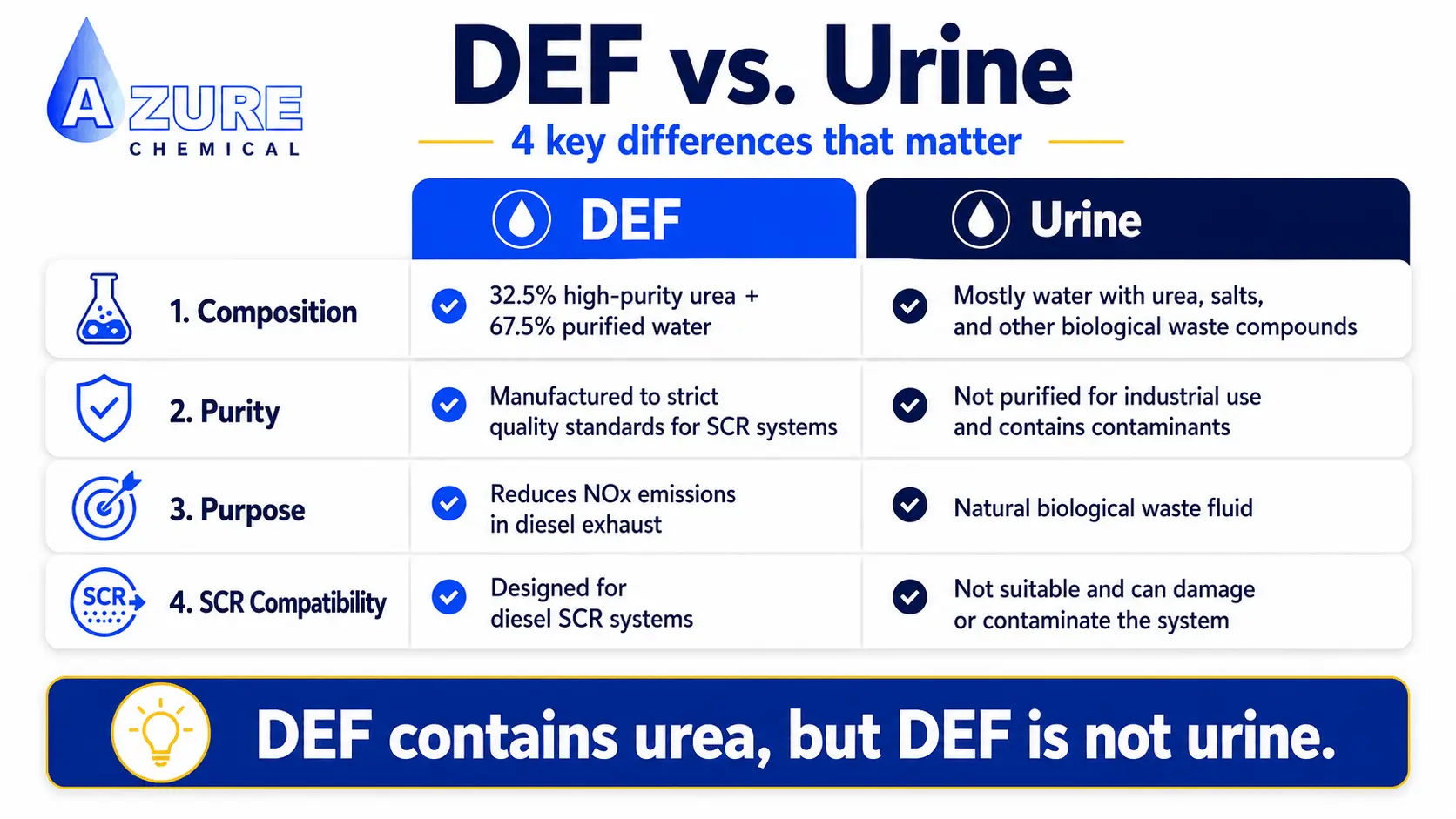
| Characteristic | DEF | Human Urine |
| Primary purpose | SCR emissions reduction | Biological waste elimination |
| Urea | Precisely controlled technical-grade urea | Naturally occurring metabolic waste |
| Water | Purified water | Biological water containing dissolved substances |
| Concentration | 32.5% urea | Far below DEF concentration |
| Minerals and salts | Strictly limited | Naturally contains electrolytes and minerals |
| Purity controlled to ISO 22241 | Yes | No |
| Appropriate for SCR systems | Yes | Absolutely not |
The crucial difference is therefore not merely whether urea exists.
It is purity, concentration, contamination control, and consistency.
Urine Contains Substances an SCR System Was Never Designed to Handle
Human urine can contain compounds and ions such as:
- sodium
- potassium
- chloride
- creatinine
- phosphates
- sulfates
- metabolic byproducts
SCR dosing systems use precision components including pumps, injectors, sensors, lines, and catalysts.
These components are designed around tightly specified DEF chemistry, not biological fluids.
What Would Happen If You Put Urine in a DEF Tank?
Do not do it.
Even though urine contains some urea, its composition is fundamentally unsuitable for an SCR system.
Potential consequences include contamination of the DEF tank and dosing system, deposits, injector problems, sensor faults, reduced NOx conversion, or broader aftertreatment-system problems.
API warns that using low-quality or contaminated DEF can contribute to catalyst poisoning, injector and filter clogging, deposit formation, restricted equipment operation, repairs, and downtime.
Urine would be dramatically outside the purity specifications required of proper DEF.
The SCR System Does Not Simply Ask, "Is Urea Present?"
It effectively depends on a much stricter question:
Is the fluid within the required chemical concentration and contaminant limits for which the system was engineered?
That is why improvised substitutes are risky even when their ingredients sound superficially similar.
Can You Make DEF From Fertilizer-Grade Urea Instead?
This is another variation of the same misconception.
If industrial urea rather than urine is used, could someone buy agricultural urea, mix it with water at 32.5%, and make DEF?
That is also not recommended.
DEF-grade and fertilizer-grade materials may both contain the chemical compound urea, but they are produced and controlled for different uses.
ISO's definition of technically pure urea for AUS 32 specifically limits substances and contaminants that could be inappropriate in an SCR system.
So the hierarchy is important:
Urine ≠ fertilizer-grade urea ≠ DEF-grade urea solution
They may all relate to the same chemical compound, but they are not the same material or intended for the same application.
How Does the Urea in DEF Actually Clean Diesel Exhaust?
Understanding what happens after DEF enters the vehicle helps explain why its purity matters.
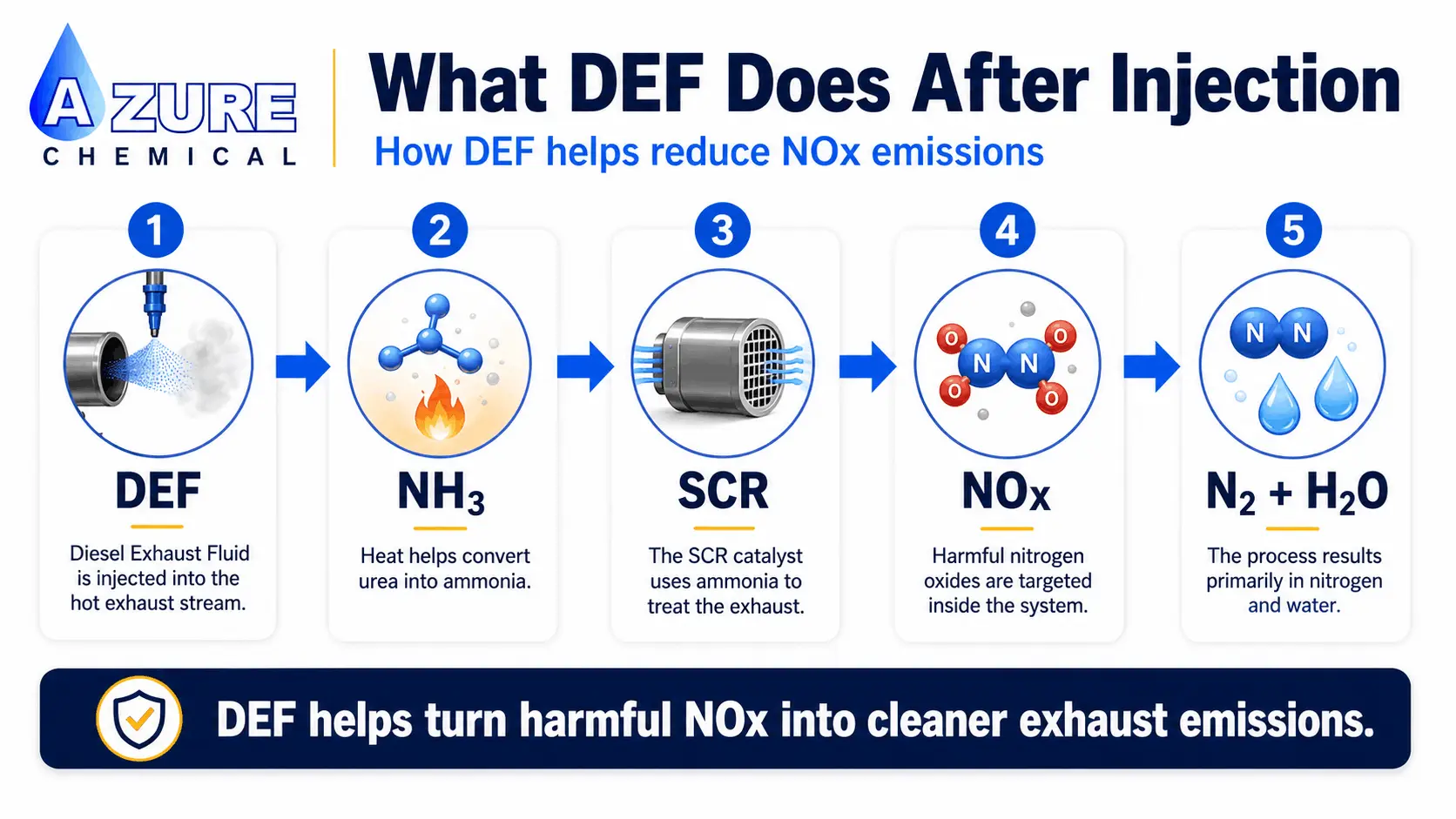
DEF does not go into the engine cylinders and does not mix with diesel fuel.
Instead:
1. Diesel Combustion Produces NOx
High-temperature combustion in diesel engines can produce nitrogen oxides, collectively called NOx.
2. DEF Is Injected Into the Exhaust
A controlled amount of DEF is sprayed into the hot exhaust stream after combustion.
3. Urea Produces Ammonia
Heat causes the urea to decompose and ultimately generate ammonia.
4. Ammonia Enters the SCR Catalyst
Inside the Selective Catalytic Reduction system, ammonia reacts with nitrogen oxides.
5. NOx Is Converted Primarily Into Nitrogen and Water
The resulting exhaust contains substantially less NOx.
API describes SCR similarly: DEF is introduced into diesel exhaust, and the combination of exhaust heat, DEF, and the catalyst converts NOx into nitrogen and water vapor.
Azure provides a more detailed technical breakdown in its explanation of how Selective Catalytic Reduction works.
DEF works in the exhaust system, not the fuel tank. Its high-purity urea generates the ammonia needed for SCR to reduce NOx.
This would be especially useful immediately after this section because it resolves two misconceptions simultaneously: where DEF goes and what urea actually does.
Why DEF Purity Matters More Than Most Drivers Realize
Many drivers understandably focus on whether the DEF tank is full.
Fleet operators need to think one step further:
Is the fluid actually within specification?
SCR systems are built around precise chemical dosing. A full tank of contaminated or off-spec fluid can be more problematic than simply having a low fluid level.
Potential contamination sources include:
- dirty dispensing equipment
- unsuitable storage containers
- diesel fuel
- lubricants
- minerals from non-purified water
- dust and debris
- incorrect urea mixtures
- other chemicals
API recommends dedicated equipment for bulk DEF handling specifically to reduce cross-contamination risks.
Azure's guide to the causes of poor-quality Diesel Exhaust Fluid covers contamination, storage, and concentration problems in more depth.
How Can You Tell Whether DEF Is Legitimate?
Consumers and fleet operators usually cannot verify every chemical specification visually, so sourcing matters.
Look for a Recognized Quality Standard
DEF used in diesel SCR systems should conform to the applicable AUS 32/ISO 22241 requirements.
The currently published ISO 22241-1:2019 specifies the quality characteristics of AUS 32 used in diesel SCR converter systems. ISO is also preparing the next edition, but the 2019 edition remains the published standard while that revision progresses.
Check for API Certification
API maintains a DEF certification program and recommends looking for the API DEF Certification Mark when purchasing packaged fluid.
Pay Attention to Storage and Handling
Even correctly manufactured DEF can be compromised after production through poor handling or contamination.
For high-volume users, supplier quality therefore includes more than what leaves the production plant. Storage tanks, pumps, hoses, transport equipment, and dispensing procedures all become part of maintaining DEF quality.
Azure's DEF 32 product and quality-control information explains the company's DEF composition, standards, packaging, and bulk-delivery options.
Common DEF Myths, Corrected
Myth: DEF Is Just Urine
Reality: DEF contains industrially produced urea and purified water. It is manufactured to controlled specifications and is not produced from urine.
Myth: If Urine Contains Urea, It Should Work in a DEF Tank
Reality: The SCR system requires precise concentration and contaminant limits. Simply containing urea is nowhere near sufficient.
Myth: DEF Goes Into the Diesel Fuel
Reality: DEF has its own tank and is dosed into the exhaust after combustion.
Myth: Any Type of Urea Can Be Used to Make DEF
Reality: Technical purity matters. Agricultural urea or improvised mixtures can contain substances inappropriate for SCR equipment.
Myth: Watered-Down DEF Should Still Work
Reality: Diluting DEF changes the standardized formulation the system is designed to use.
What Should You Do If the Wrong Fluid Enters the DEF Tank?
If urine, diesel fuel, coolant, tap water, or another unintended fluid enters the DEF tank, avoid assuming the system can simply "burn through it."
The appropriate response depends on the vehicle and extent of contamination.
A safer course is to:
- Stop adding fluid immediately.
- Avoid operating the vehicle if significant contamination is suspected.
- Consult the vehicle or engine manufacturer's service guidance.
- Have the DEF tank and system inspected or drained if required.
- Replace contaminated DEF with in-specification fluid.
The exact service procedure should come from the OEM or a qualified technician because SCR layouts and contamination procedures vary between vehicles.
Why the "DEF Is Urine" Myth Matters for Fleets
For an individual pickup owner, this misconception may simply lead to an awkward joke.
For a commercial fleet, it can become an expensive maintenance misunderstanding.
A transportation or equipment operation may consume substantial quantities of DEF across:
- tractors
- delivery vehicles
- construction equipment
- agricultural machinery
- buses
- generators
- off-road diesel equipment
At that scale, maintaining a clean supply chain becomes operationally important.
A fleet should know:
who supplied the DEF → how it was stored → what equipment dispensed it → whether the equipment remained dedicated → how long the fluid has been stored
That traceability is much more meaningful than viewing DEF as "just urea and water."
Frequently Asked Questions
Is DEF Fluid Made From Urine?
No. DEF fluid is manufactured from industrially produced, technically pure urea and purified water. Although urine naturally contains urea, DEF itself is not produced from human or animal urine.
Is Urea the Same Thing as Urine?
No. Urea is a chemical compound. Urine is a biological fluid containing water, urea, salts, minerals, metabolic waste, and other compounds.
What Percentage of DEF Is Urea?
Standard automotive DEF, also called AUS 32, contains 32.5% urea by mass.
What Is the Rest of DEF Made From?
The remaining approximately 67.5% is purified water.
Is the Urea in DEF Synthetic?
The urea used for DEF is industrially produced. Commercial urea manufacturing reacts ammonia and carbon dioxide through an industrial chemical process.
Can You Pee Into a DEF Tank in an Emergency?
No. Urine does not meet DEF concentration or purity requirements and may contaminate or damage components of the DEF/SCR system.
Can I Make My Own DEF?
It is not advisable. Meeting the proper concentration alone does not guarantee the contaminant limits and quality characteristics required by ISO 22241.
Is Fertilizer Urea the Same as DEF Urea?
The underlying urea molecule is the same, but the required purity, permitted contaminants, processing, and intended applications differ. Fertilizer-grade urea should not be assumed suitable for manufacturing automotive DEF.
Does DEF Go Into the Engine?
No. DEF is introduced into the exhaust after combustion as part of the SCR aftertreatment process.
Why Does DEF Smell Slightly Like Ammonia?
Urea chemistry is closely related to ammonia, and small amounts of ammonia can be present or become noticeable under certain conditions. A mild ammonia-like odor does not mean DEF is urine.
The Bottom Line: Is DEF Fluid Made From Urine?
No, DEF fluid is not made from urine.
The myth exists because both contain urea, but that similarity ends quickly.
Proper Diesel Exhaust Fluid is a precisely formulated solution containing 32.5% technically pure, industrially produced urea and 67.5% purified water. Its chemistry and contamination limits are tightly controlled because the fluid must work reliably with sensitive SCR injectors, sensors, and catalysts.
Human or animal urine contains the wrong urea concentration and numerous additional substances that have no place in a diesel aftertreatment system.
For fleet operators, distributors, equipment owners, and businesses that consume DEF regularly, the more useful question is therefore not just "Does this contain urea?"
It is:
Does this DEF meet the quality specification my SCR system was engineered to use?
Azure Chemical supplies high-quality Diesel Exhaust Fluid for SCR-equipped diesel applications and bulk commercial requirements. For supply, delivery, or distribution inquiries, contact Azure Chemical.