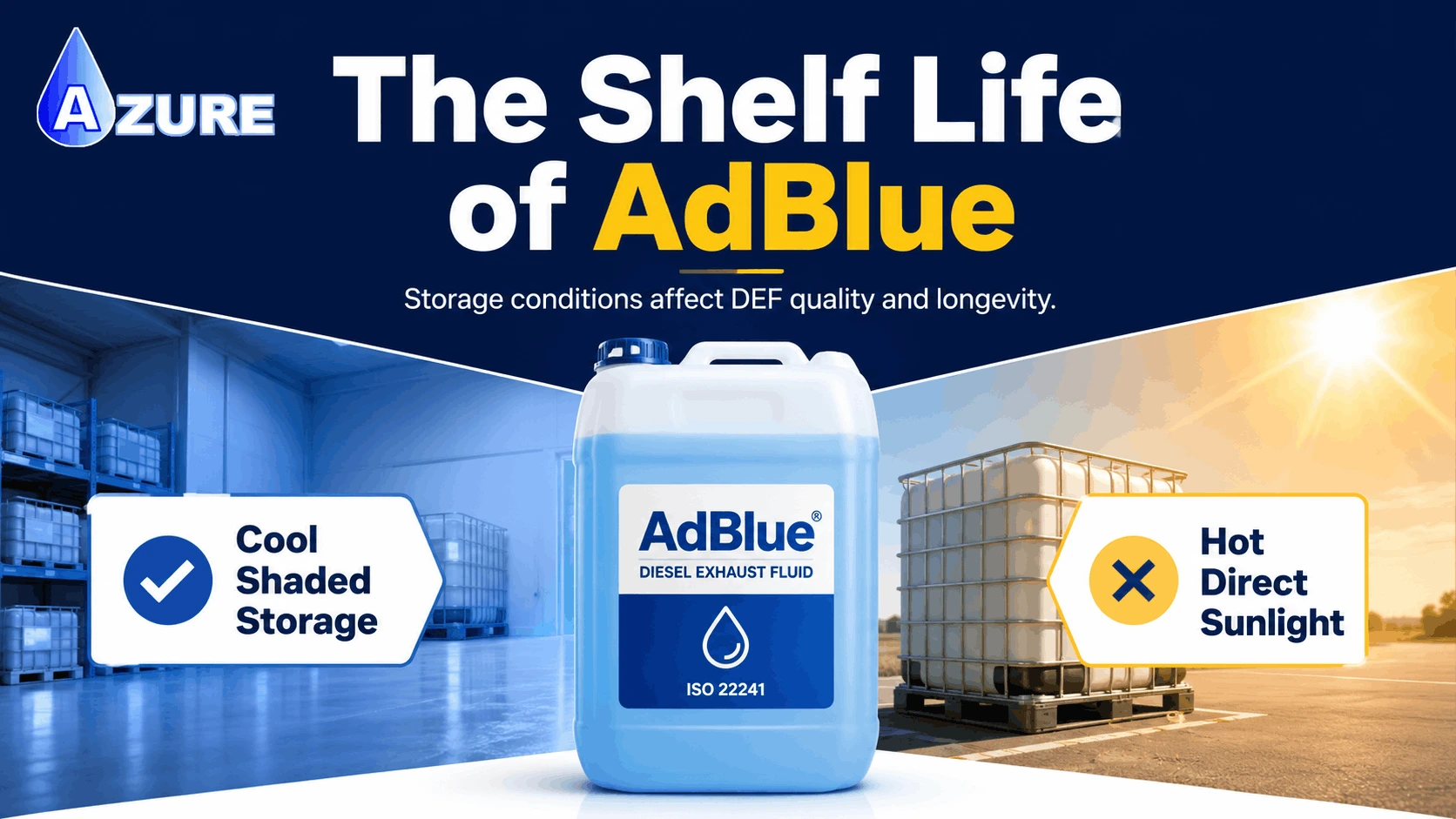
The shelf life of AdBlue is typically at least 12 months when Diesel Exhaust Fluid is stored correctly, but that number should not be treated as a universal expiration date.
Temperature, direct sunlight, contamination, container condition, and the manufacturer's dating all influence how long the fluid remains suitable for use.
According to the American Petroleum Institute’s DEF consumer guidance, properly stored DEF can last 12 months or longer. Under favorable conditions, longer storage may be possible. The VDA’s official AdBlue guidance also emphasizes proper handling, temperature control, and protection from contamination when storing AdBlue.
For drivers and fleet managers, the practical lesson is straightforward:
Do not evaluate AdBlue only by how old it is. Consider its date, temperature history, storage environment, container condition, and contamination risk.
In this blog, we'll provide additional information about DEF composition, commercial applications, handling, and supply.
Contents
- 1 Is AdBlue the Same as DEF?
- 2 How Long Is the Shelf Life of AdBlue?
- 3 Why Does AdBlue Have a Shelf Life?
- 4 How Temperature Affects the Shelf Life of AdBlue
- 5 Does AdBlue Go Bad If It Freezes?
- 6 Frozen DEF Expands
- 7 Does Sunlight Reduce AdBlue Shelf Life?
- 8 How Storage Containers Affect AdBlue Shelf Life
- 9 Opened vs. Unopened AdBlue
- 10 How Can You Tell If AdBlue Has Gone Bad?
- 11 Can You Test Old AdBlue Before Disposing of It?
- 12 Why Poor-Quality AdBlue Can Become Expensive
- 13 The Best Way for Fleets to Manage AdBlue Shelf Life
- 14 A Practical AdBlue Receiving Checklist
- 15 Suggested Infographic: Fleet DEF Storage Checklist
- 16 How Long Can DEF Stay in a Vehicle?
- 17 Is Expired AdBlue Automatically Bad?
- 18 AdBlue Shelf Life by Storage Scenario
- 19 Frequently Asked Questions
- 19.1 What Is the Shelf Life of AdBlue?
- 19.2 Does AdBlue Expire?
- 19.3 Does Heat Shorten DEF Shelf Life?
- 19.4 What Temperature Should AdBlue Be Stored At?
- 19.5 Does AdBlue Go Bad After Freezing?
- 19.6 At What Temperature Does AdBlue Freeze?
- 19.7 Should Frozen DEF Be Diluted With Water?
- 19.8 Can DEF Last Two Years?
- 19.9 How Can I Tell Whether Old AdBlue Is Still Good?
- 19.10 Is Opened AdBlue Still Usable?
- 19.11 Does Direct Sunlight Damage AdBlue?
- 19.12 Can Contaminated DEF Be Filtered and Reused?
- 20 The Bottom Line: How Long Does AdBlue Last?
Is AdBlue the Same as DEF?
For storage and shelf-life purposes, AdBlue and DEF refer to the same standardized type of fluid: AUS 32.
It consists of:
- 32.5% technically pure urea
- 67.5% purified water
AdBlue® is a registered trademark of the German Association of the Automotive Industry, or VDA, used for AUS 32 supplied under its licensing system. In North America, the fluid is more commonly called Diesel Exhaust Fluid, or DEF.
The VDA’s official AdBlue guidance explains that AdBlue quality is based on the ISO 22241 series of standards.
So although the terminology differs by market, guidance about DEF storage is generally relevant when discussing the shelf life of AdBlue.
How Long Is the Shelf Life of AdBlue?
There is no single number that applies to every container under every storage condition.
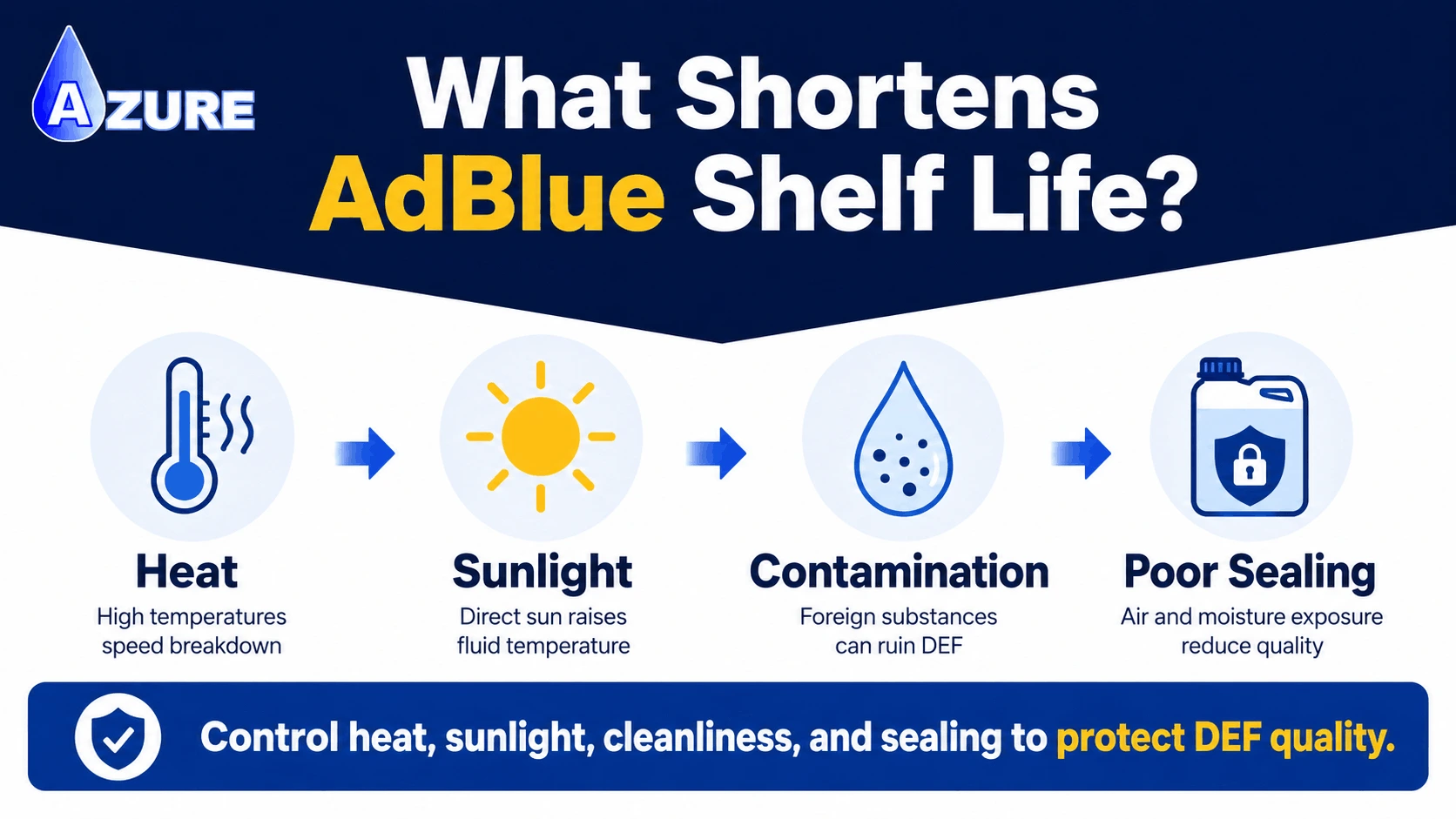
A better way to understand AdBlue shelf life is to consider the environment in which it has been stored.
| Storage Condition | Practical Guidance |
|---|---|
| Cool, shaded, sealed storage | Commonly 12 months or longer |
| Favorable controlled storage | Longer storage may be possible depending on manufacturer guidance |
| Sustained temperatures around 86°F / 30°C or higher | Shelf life may shorten significantly |
| Direct sunlight and uncontrolled outdoor heat | Faster deterioration is possible |
| Contaminated DEF | May be unsuitable regardless of age |
The API guidance on maintaining DEF quality explains that heat and improper storage can reduce the expected life of DEF.
Manufacturer Dates Should Take Priority
If the DEF container has a production date, expiration date, or best-before date, use that information as your primary reference.
Manufacturers establish dating based on factors including:
- packaging
- product testing
- expected storage conditions
- manufacturing controls
- anticipated degradation
A generic online rule should not override product-specific manufacturer guidance.
Why Does AdBlue Have a Shelf Life?
AdBlue contains only two primary ingredients, but the finished fluid must remain within tightly controlled chemical limits.
Its usable life can decline because of heat, evaporation, chemical decomposition, or contamination.
Urea Can Gradually Degrade
High temperatures accelerate chemical reactions.
DEF stored in a cool warehouse and DEF stored outdoors through a hot summer may therefore age very differently, even if both containers were manufactured on the same day.
This is why storage temperature is one of the most important factors affecting the shelf life of AdBlue.
Water Loss Can Change the Concentration
DEF relies on a controlled 32.5% urea concentration.
If a poorly sealed container loses water through prolonged exposure to heat, the solution may gradually move away from its intended composition.
This is one reason containers should remain properly closed when not in use.
Contamination Can Make New DEF Unusable
Calendar age is only one aspect of DEF quality.
A recently manufactured batch contaminated with diesel fuel, dirt, oil, coolant, tap water, or another chemical may pose more risk to the SCR system than an older batch that has been stored correctly.
The ISO 22241-3 handling and storage standard addresses practices for maintaining the quality of AUS 32 during transportation, storage, and handling.
Azure also covers this topic in its guide to special DEF storage requirements.
How Temperature Affects the Shelf Life of AdBlue
Temperature is one of the strongest variables affecting DEF longevity.
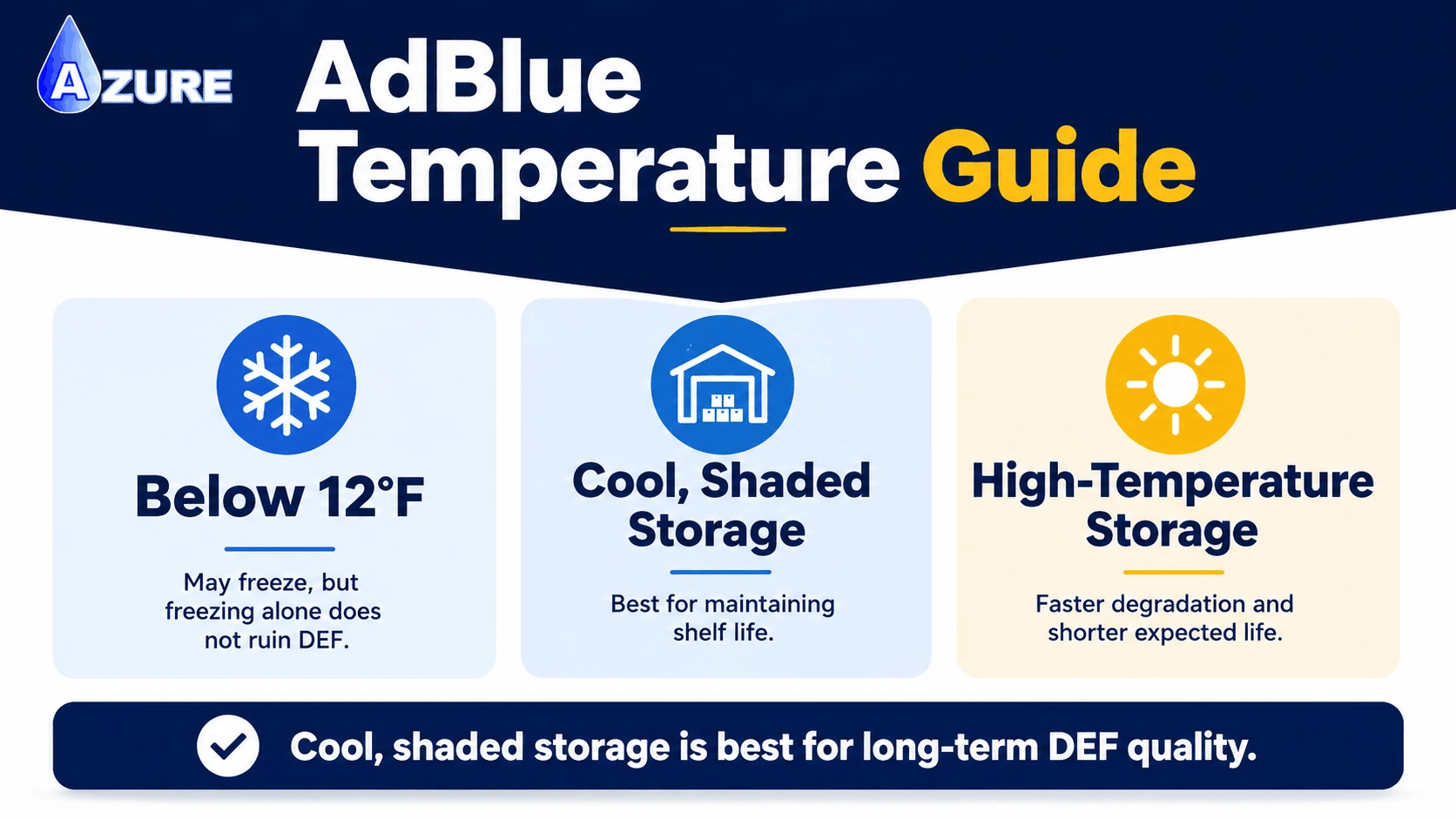
Heat Is Usually the Bigger Long-Term Concern
Sustained heat can accelerate DEF degradation.
According to API guidance on maintaining DEF quality, prolonged exposure to elevated temperatures can shorten DEF's expected shelf life.
This matters particularly for:
- outdoor IBC totes
- drums stored against sun-exposed walls
- spare containers stored in truck cabs
- unconditioned warehouses
- fleets operating in hot climates
- construction yards in desert environments
A container may look perfectly normal while having spent months exposed to high internal temperatures.
Storage Temperature Matters More Than Outdoor Temperature Alone
The temperature inside a container sitting under direct sunlight can differ substantially from the reported outdoor air temperature.
Fleet managers storing DEF outdoors should therefore think about:
container temperature, not merely weather forecasts.
Azure Chemical's guide to the ideal DEF temperature provides additional information about temperature management.
Practical Fleet Rule
When DEF will remain in inventory for months rather than weeks:
Keep it cool, shaded, sealed, and away from direct solar exposure.
Does AdBlue Go Bad If It Freezes?
Freezing does not automatically ruin properly formulated AdBlue.
AdBlue freezes at approximately 12°F (-11°C).
The VDA AdBlue technical information explains that frozen AdBlue can be used again after thawing.
This distinction is important because freezing and heat exposure affect DEF differently.
Freezing Is Not the Same as Heat Degradation
Cold temperatures temporarily turn DEF solid.
High temperatures can accelerate chemical deterioration over time.
Once properly formulated DEF completely thaws, the solution should return to its normal liquid state.
Do Not Add Water to Frozen DEF
Adding water changes the urea concentration and may introduce contaminants.
The API guidance for handling Diesel Exhaust Fluid advises users to maintain DEF purity rather than attempting to modify the fluid.
Do not add:
- tap water
- distilled water
- antifreeze
- diesel additives
- alcohol
- other chemicals
to accelerate thawing.
Modern SCR-equipped vehicles commonly include systems designed to thaw DEF during cold-weather operation.
Frozen DEF Expands
Freezing introduces another practical issue for bulk storage.
DEF expands when it freezes.
Containers that are completely filled may therefore experience additional physical stress if exposed to temperatures below the freezing point.
Fleet managers in colder regions should leave appropriate expansion space according to container and supplier recommendations.
This is particularly important for:
- rigid storage tanks
- drums
- IBC totes
- fixed bulk installations
Does Sunlight Reduce AdBlue Shelf Life?
Yes, particularly when sunlight raises the temperature of the stored fluid.
Direct solar exposure can cause drums and totes to become much hotter than the surrounding air.
The American Petroleum Institute’s DEF consumer guidance recommends keeping DEF stored in conditions that protect the fluid from excessive heat and contamination.
Outdoor storage therefore deserves more attention than simply placing a container somewhere convenient.
Better Outdoor DEF Storage
When indoor storage is not possible, a storage setup should consider:
- shade
- ventilation
- compatible tank materials
- clean dispensing equipment
- protection from contamination
- temperature exposure
- appropriate inventory turnover
Simply covering an IBC tote without considering heat buildup is not necessarily sufficient.
How Storage Containers Affect AdBlue Shelf Life
Temperature receives considerable attention, but container compatibility and cleanliness can be equally important.
DEF is sensitive to contamination.
The ISO 22241-3 handling and storage standard addresses storage, transportation, and handling practices intended to maintain AUS 32 quality.
Use Dedicated DEF Equipment
Pumps, hoses, nozzles, funnels, tanks, and transfer equipment used for DEF should ideally remain dedicated to DEF.
API similarly recommends dedicated DEF storage and dispensing equipment to reduce contamination risks.
A container previously used for another fluid should not automatically be repurposed for DEF.
Examples include containers previously holding:
- diesel
- oil
- coolant
- windshield washer fluid
- detergents
- agricultural chemicals
- lubricants
Even small amounts of certain contaminants can interfere with SCR components.
Opened vs. Unopened AdBlue
An unopened container generally has fewer opportunities for contamination.
Once a container is opened, each transfer introduces potential exposure to:
- dust
- dirty funnels
- moisture
- contaminated caps
- unsuitable pumps
- fuel residue
- lubricant residue
This does not mean opened DEF immediately expires.
It means handling becomes more important.
Best Practices for Opened DEF
After opening a container:
Close it tightly.
Keep the dispensing area clean.
Avoid transferring DEF with multi-purpose funnels or pumps.
Store it away from heat and sunlight.
Record when the container was opened if inventory turnover is slow.
These simple procedures can be especially valuable for fleets using smaller volumes of DEF.
How Can You Tell If AdBlue Has Gone Bad?
Proper DEF is normally clear and colorless.
Obvious warning signs can include:
- cloudiness
- unusual color
- debris
- sediment
- particles
- oil contamination
- damaged seals
- foreign material
However, appearance alone cannot confirm that DEF meets every ISO specification.
A fluid can look clear while still having incorrect concentration or contamination levels.
Azure's guide to whether Diesel Exhaust Fluid goes bad examines DEF deterioration in more detail.
Can You Test Old AdBlue Before Disposing of It?
For significant commercial quantities, testing may make more sense than guessing.
Imagine a fleet with a nearly full IBC tote that has been sitting for an extended period. Discarding hundreds of gallons purely because of age could be unnecessarily expensive.
Using questionable fluid without verification could be even more expensive.
Possible DEF quality checks include:
- urea concentration
- refractive index
- contamination
- appearance
- applicable ISO quality characteristics
Azure's AdBlue testing guide provides additional information about evaluating DEF quality.
For substantial inventory, professional testing is more reliable than relying on appearance alone.
Why Poor-Quality AdBlue Can Become Expensive
DEF itself represents only a small part of the emissions-control system.
The SCR system can include:
- DEF pumps
- injectors
- sensors
- dosing modules
- heated lines
- catalyst assemblies
- electronic controls
The American Petroleum Institute’s DEF quality guidance warns that low-quality or contaminated DEF can contribute to deposits, injector problems, catalyst issues, restricted equipment operation, repair costs, and downtime.
For an individual pickup owner, that may mean an inconvenient repair.
For a commercial fleet, the larger cost may be:
a truck that cannot complete its route.
That is why DEF shelf-life management should be considered a maintenance and inventory-control issue, not merely a question of whether fluid has reached a particular birthday.
The Best Way for Fleets to Manage AdBlue Shelf Life
Commercial operations benefit from treating DEF like any other controlled consumable.
Use First In, First Out
A FIFO inventory system prevents newer deliveries from consistently being used before older stock.
Record:
- delivery date
- production date
- lot number
- supplier
- manufacturer dating
- container identification
Then use the oldest acceptable inventory first.
Match Purchase Volume to Actual Consumption
Buying a larger volume may reduce the unit price, but larger orders are not automatically more economical.
Consider two operations:
Fleet A consumes 100 gallons per month.
Fleet B consumes 2,000 gallons per month.
An IBC tote may represent efficient inventory for Fleet B but excessive long-term storage for Fleet A.
The real purchasing decision should consider:
product price + delivery cost + consumption rate + storage conditions + inventory turnover
This is a more useful calculation than simply buying the largest quantity available.
Monitor Storage Temperature
For outdoor or hot-climate installations, tracking actual DEF storage temperature can reveal more than monitoring ambient air temperature.
This is especially relevant for fleets in:
- Southern California
- Arizona
- Nevada
- Texas
- other high-temperature operating environments
Inspect the Dispensing System
A high-quality DEF supply can become contaminated at the final point of transfer.
That means fleet maintenance should include inspection of:
- hoses
- pumps
- nozzles
- fittings
- tank caps
- transfer connections
Quality control does not stop when DEF arrives at your facility.
A Practical AdBlue Receiving Checklist
Fleet managers can use a simple five-step check whenever a new DEF shipment arrives.
1. Verify the Product and Supplier
Confirm the supplier, product specification, container condition, and relevant certification.
The American Petroleum Institute’s DEF consumer guidance also provides information about API-certified DEF.
2. Record Batch Information
Document:
- batch or lot number
- delivery date
- supplier
- quantity
- best-before date
Traceability can become valuable if a later quality issue affects multiple vehicles.
3. Inspect the Container
Look for:
- damaged seals
- leaks
- damaged caps
- debris
- contamination
- evidence of incorrect storage
4. Move DEF Into Proper Storage
A correctly delivered product should not remain exposed to direct sunlight for weeks simply because it has not yet been moved.
5. Rotate Existing Inventory
Whenever practical, place the newest stock behind older acceptable inventory.
This makes FIFO easier to maintain.
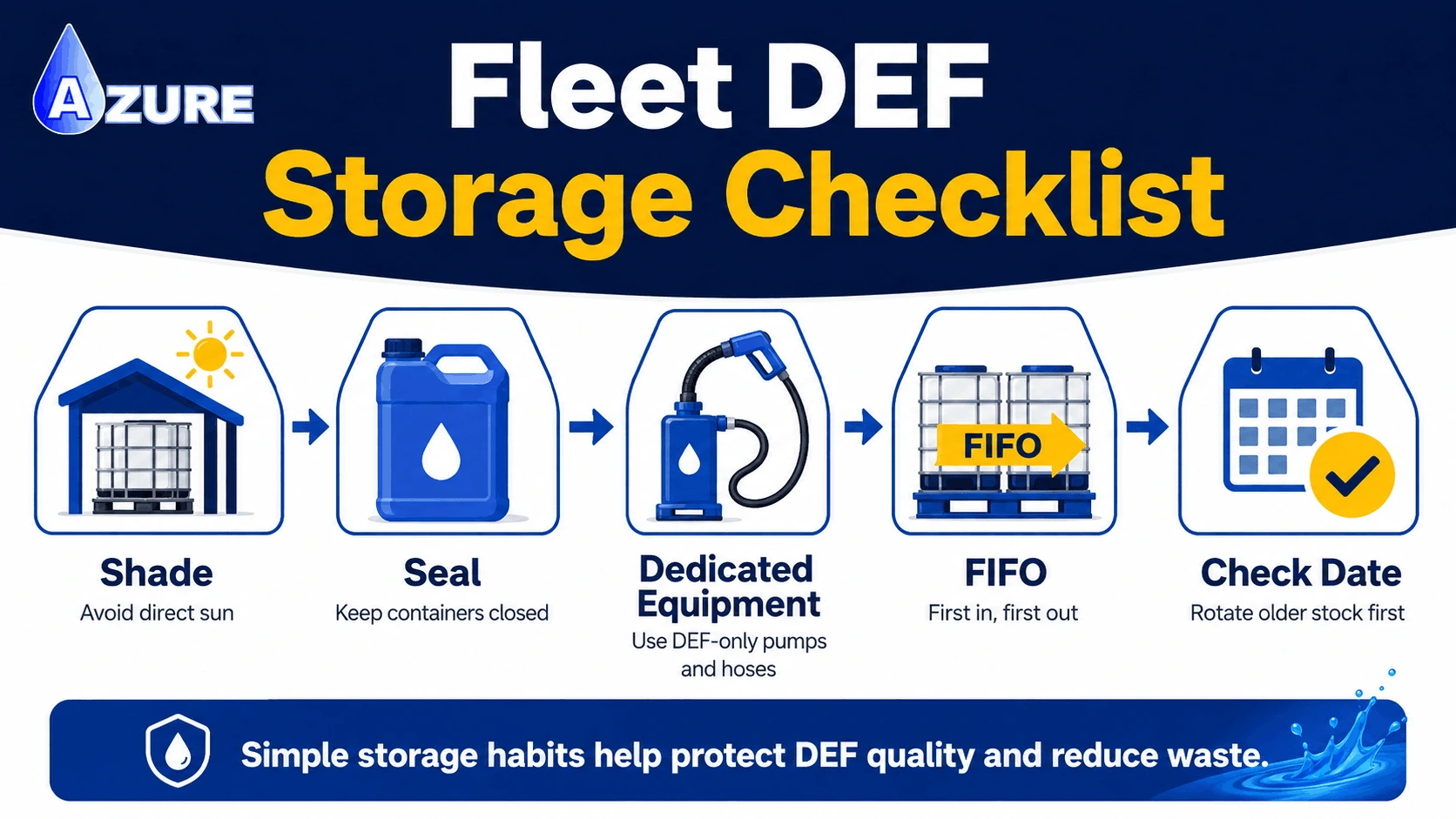
Suggested Infographic: Fleet DEF Storage Checklist
A clean five-icon visual can reinforce the key actions:
Shade → Seal → Dedicated Equipment → FIFO → Check Date
This provides a useful mobile-friendly summary without repeating the article's table.
How Long Can DEF Stay in a Vehicle?
DEF stored in a vehicle experiences a different environment from warehouse inventory.
The tank may experience:
- repeated heating and cooling
- vibration
- seasonal temperature swings
- prolonged parking
- periods of low consumption
A vehicle that consumes DEF regularly naturally rotates its inventory.
A truck parked for months in a hot environment may require more attention.
When a vehicle will remain unused for a prolonged period, follow the engine or vehicle manufacturer's storage instructions.
Is Expired AdBlue Automatically Bad?
Not necessarily in the sense that DEF changes from acceptable to unusable at midnight on a particular date.
Shelf-life recommendations represent the period during which quality can reasonably be expected under specified storage conditions.
Actual deterioration depends on:
- temperature
- contamination
- sunlight
- sealing
- age
- handling
However, this should not be interpreted as permission to use old DEF indefinitely.
A more useful decision process is:
Check the manufacturer's date
↓
Review storage history
↓
Inspect the fluid
↓
Test questionable bulk inventory
↓
Replace it if quality cannot be verified
This approach is more defensible than relying on an arbitrary universal expiration rule.
AdBlue Shelf Life by Storage Scenario
Sealed Container in a Climate-Controlled Shop
This is close to an ideal environment.
Keep the container sealed, observe manufacturer dating, and rotate inventory.
IBC Tote Inside a Warehouse
Often suitable if the warehouse remains reasonably cool and the dispensing system is clean and dedicated.
IBC Tote Outdoors in a Hot Climate
Heat becomes a major consideration.
Shade, proper storage design, temperature monitoring, and faster inventory turnover become much more important.
Spare DEF Jug Inside a Truck Cab
A vehicle interior can become extremely hot.
This is not an ideal location for long-term storage.
Frozen DEF Container
Allow the DEF to thaw normally.
Do not add water or other chemicals.
Frequently Asked Questions
What Is the Shelf Life of AdBlue?
Properly stored AdBlue can generally remain usable for at least 12 months, while favorable storage conditions may support longer storage. Always follow the manufacturer’s dating and storage instructions.
Does AdBlue Expire?
Yes. DEF and AdBlue have a recommended storage life, although degradation depends on environmental conditions rather than occurring instantly on one date.
Does Heat Shorten DEF Shelf Life?
Yes. The API guidance on maintaining DEF quality explains that prolonged exposure to high temperatures can reduce DEF's expected storage life.
What Temperature Should AdBlue Be Stored At?
A cool, shaded location is preferable. For commercial storage and handling, the ISO 22241-3 DEF storage standard provides guidance for maintaining AUS 32 quality.
Does AdBlue Go Bad After Freezing?
Freezing alone does not necessarily make properly formulated AdBlue unusable. According to the VDA’s official AdBlue guidance, it can be used again after appropriate thawing.
At What Temperature Does AdBlue Freeze?
AdBlue freezes at approximately 12°F (-11°C).
Should Frozen DEF Be Diluted With Water?
No. The API guidance for handling Diesel Exhaust Fluid emphasizes maintaining the fluid's required purity and composition.
Can DEF Last Two Years?
Some products stored under favorable conditions may remain acceptable for extended periods, but you should not assume every DEF product will automatically remain suitable for two years. Follow the supplier and manufacturer's dating.
How Can I Tell Whether Old AdBlue Is Still Good?
Review its age, storage history, container condition, appearance, and contamination risk. Commercial quantities can also be tested when quality is uncertain.
Is Opened AdBlue Still Usable?
Yes, provided it remains within specification. Once opened, keeping the container sealed and preventing contamination become especially important.
Does Direct Sunlight Damage AdBlue?
It can shorten useful storage life by increasing fluid temperature, particularly when containers remain exposed for extended periods.
Can Contaminated DEF Be Filtered and Reused?
Do not assume filtration makes contaminated DEF acceptable. Different contaminants require different treatment, and fluid used in SCR systems should meet the applicable quality specification.
The Bottom Line: How Long Does AdBlue Last?
The shelf life of AdBlue cannot be reduced to one universal number.
Properly stored DEF commonly lasts 12 months or longer, while actual usable life depends heavily on temperature, sunlight, contamination, container condition, and manufacturer guidance.
The four factors fleet managers should focus on are:
Temperature
Sunlight
Contamination
Inventory age
Cold weather is often less damaging than people assume because properly formulated DEF can freeze and thaw. Sustained excessive heat and contamination generally deserve more attention during long-term storage.
For commercial operations, the best approach is to:
buy quantities that match consumption,
store DEF in compatible dedicated equipment,
keep inventory shaded and sealed,
rotate stock using FIFO,
and
verify questionable bulk inventory rather than guessing.
Azure Chemical supplies Diesel Exhaust Fluid 32% in packaging and delivery options suitable for different fleet and commercial requirements. Businesses with recurring DEF needs can also contact Azure Chemical to discuss supply, bulk delivery, and storage requirements.