
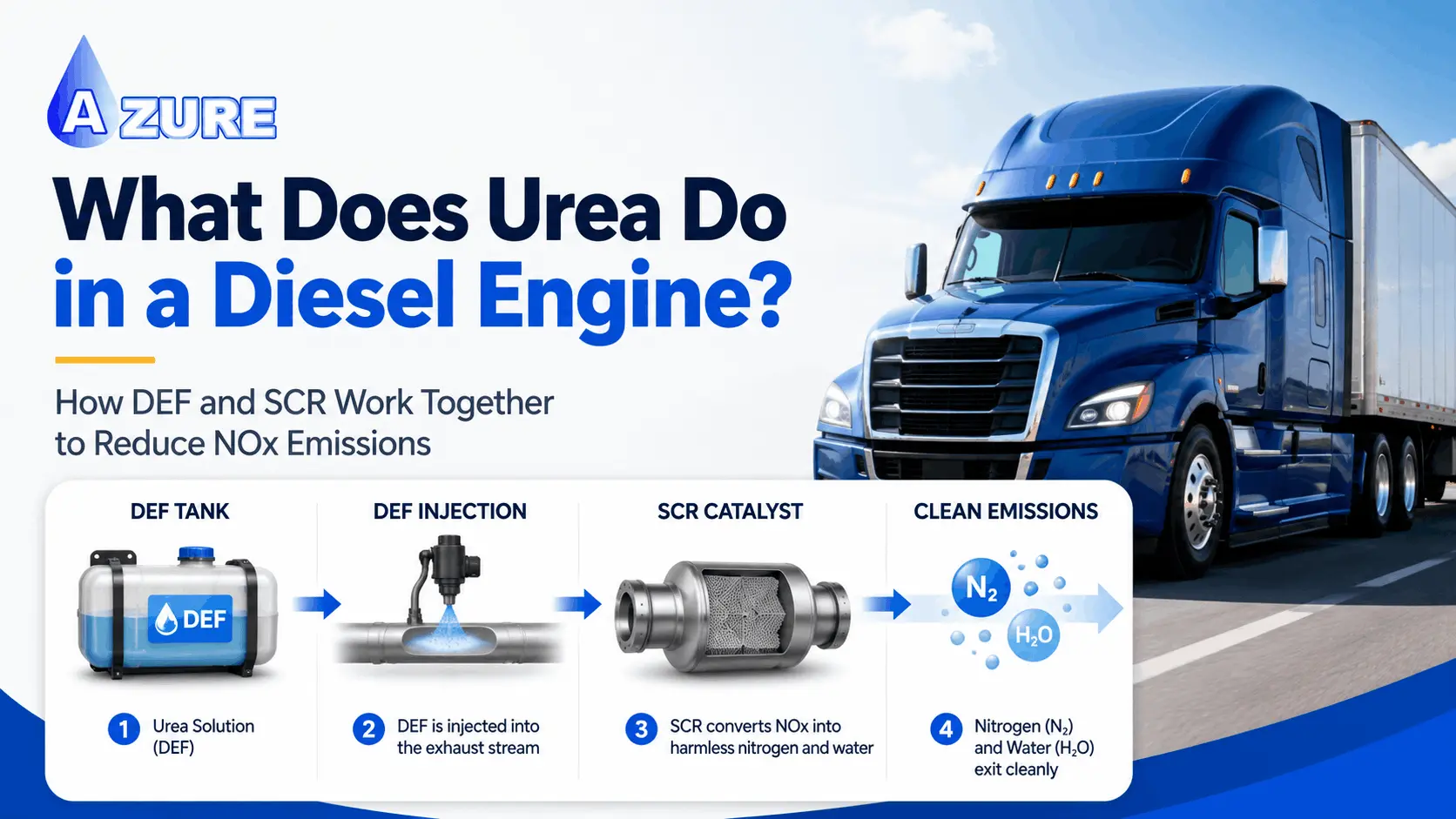
If you are wondering what does urea do in a diesel engine, the most important point is this: urea is not added to diesel fuel and it does not participate directly in combustion.
Instead, high-purity urea is one of the two ingredients in Diesel Exhaust Fluid, commonly called DEF. DEF is injected into the hot exhaust stream of diesel engines equipped with Selective Catalytic Reduction, or SCR. Heat converts the urea into ammonia, and that ammonia reacts with nitrogen oxides inside the SCR catalyst. The process converts much of the harmful NOx into primarily nitrogen and water.
In other words, urea helps clean the exhaust after the diesel fuel has already burned.
The American Petroleum Institute explains that automotive DEF, also known as AUS 32, contains 32.5% technically pure urea in purified water and is used with SCR systems to reduce nitrogen oxide emissions. American Petroleum Institute DEF guidance ISO 22241 defines the quality requirements for the AUS 32 used in diesel-engine SCR systems. ISO 22241-1 quality standard
For operators who want a broader introduction to the fluid itself, Azure Chemical's Diesel Exhaust Fluid guide explains DEF applications, supply, storage, and common operating concerns.
Contents
- 1 Does Urea Go Into the Diesel Engine?
- 2 How Urea Reduces NOx Emissions
- 3 What Happens Inside the SCR Catalyst?
- 4 Why Is DEF Exactly 32.5% Urea?
- 5 Can Regular Fertilizer Urea Be Used Instead of DEF?
- 6 Why DEF Quality Matters to the SCR System
- 7 Does Urea Improve Diesel Engine Performance?
- 8 What Happens If a Diesel Vehicle Runs Out of DEF?
- 9 Does Every Diesel Engine Use Urea?
- 10 What Is the Difference Between Urea, DEF, and SCR?
- 11 Common Misconceptions About Urea in Diesel Engines
- 12 Practical DEF Tips for Fleet and Equipment Operators
- 13 Why Urea-Based SCR Became Important for Diesel Engines
- 14 Frequently Asked Questions
- 14.1 What Does Urea Do in a Diesel Engine?
- 14.2 Is Urea Mixed With Diesel Fuel?
- 14.3 Is DEF the Same as Urea?
- 14.4 Why Is Urea Used Instead of Ammonia?
- 14.5 Does Urea Remove Carbon Dioxide From Diesel Exhaust?
- 14.6 Does DEF Reduce Diesel Particulate Matter?
- 14.7 Can Poor-Quality DEF Damage an SCR System?
- 14.8 How Much DEF Does a Diesel Engine Use?
- 14.9 Can a Diesel Engine Run Without DEF?
- 15 The Bottom Line: What Does Urea Do in a Diesel Engine?
Does Urea Go Into the Diesel Engine?
No. This distinction is critical.
When people talk about "urea in a diesel engine," they are usually referring to the DEF and SCR aftertreatment system attached to the vehicle or equipment.
DEF has its own storage tank. It is not poured into:
- the diesel fuel tank
- the engine oil
- the coolant reservoir
- the combustion chamber
The DEF dosing system sends a controlled quantity of fluid into the exhaust after combustion has taken place.
Putting DEF into the diesel fuel tank is therefore a contamination event, not a normal part of engine operation. If that happens, do not start the vehicle unless the manufacturer or a qualified technician specifically instructs otherwise. Azure Chemical explains the issue in more detail in its guide to what happens when DEF is put in a diesel tank.
How Urea Reduces NOx Emissions
Understanding what urea does in a diesel engine becomes much easier when the process is viewed step by step.
| Stage | What Happens | Why It Matters |
|---|---|---|
| Diesel combustion | Fuel burns inside the engine and produces exhaust containing nitrogen oxides | NOx contributes to air-quality problems |
| DEF dosing | DEF is sprayed into the exhaust stream | Introduces high-purity urea into the aftertreatment system |
| Urea decomposition | Exhaust heat helps convert urea into ammonia | Ammonia becomes the active reducing agent |
| SCR reaction | Ammonia reacts with NOx across the catalyst | Converts NOx primarily into nitrogen and water |
| System monitoring | Sensors and the engine control system monitor exhaust conditions | Helps regulate DEF dosing and emissions performance |
Step 1: The Diesel Engine Produces NOx
Diesel engines operate with high compression ratios and high combustion temperatures. These characteristics contribute to diesel efficiency and torque, but they can also promote the formation of nitrogen oxides.
NOx is a collective term for nitrogen oxide compounds, particularly nitric oxide and nitrogen dioxide, produced during combustion.
This is why modern diesel vehicles often require several emissions-control technologies rather than relying on combustion changes alone.
Step 2: DEF Is Injected Into the Exhaust
Once exhaust gases leave the engine, the SCR system can inject DEF into the exhaust stream.
The amount is not arbitrary. Modern systems use operating data such as engine load, exhaust temperature, NOx measurements, and other parameters to determine appropriate dosing.
This is one reason DEF should not be treated like a generic additive. Its composition and the accuracy of the dosing system matter.
For a deeper explanation of the hardware and emissions-control process, see Azure Chemical's guide to how a Selective Catalytic Reduction system works.
Step 3: Urea Produces Ammonia
DEF consists of high-purity urea dissolved in purified water.
As the injected DEF encounters hot exhaust, the water evaporates and the urea undergoes thermal decomposition and hydrolysis reactions that ultimately generate ammonia.
A simplified overall representation is:
Urea + water → ammonia + carbon dioxide
The ammonia is the key reactant needed for the next stage.
This point corrects a common misunderstanding. Urea itself does not simply "absorb" NOx. Its value in SCR comes largely from its ability to safely transport and generate ammonia within the exhaust aftertreatment process.
Readers interested in the ingredient itself can learn more about what urea in DEF is and why its concentration matters.
What Happens Inside the SCR Catalyst?
Once ammonia reaches the SCR catalyst, it reacts selectively with nitrogen oxides in the exhaust.
The chemistry can follow several reaction pathways depending on the proportions of NO and NO₂, exhaust temperature, catalyst design, and operating conditions. The useful end products are primarily:
Nitrogen (N₂)
and
Water (H₂O)
Both are naturally present in the environment.
Research included in the U.S. Environmental Protection Agency's HERO database documents urea-SCR as a well-established method for reducing NOx from diesel exhaust and highlights the importance of catalyst temperature, dosing, and operating conditions. EPA research on urea-based selective catalytic reduction
This nuance matters because claims such as "SCR always removes exactly 90% of NOx" are too simplistic. Actual NOx conversion depends on the engine, catalyst, exhaust temperature, calibration, duty cycle, DEF dosing, and system condition.
Why Is DEF Exactly 32.5% Urea?
Automotive DEF is not simply "water with some urea added."
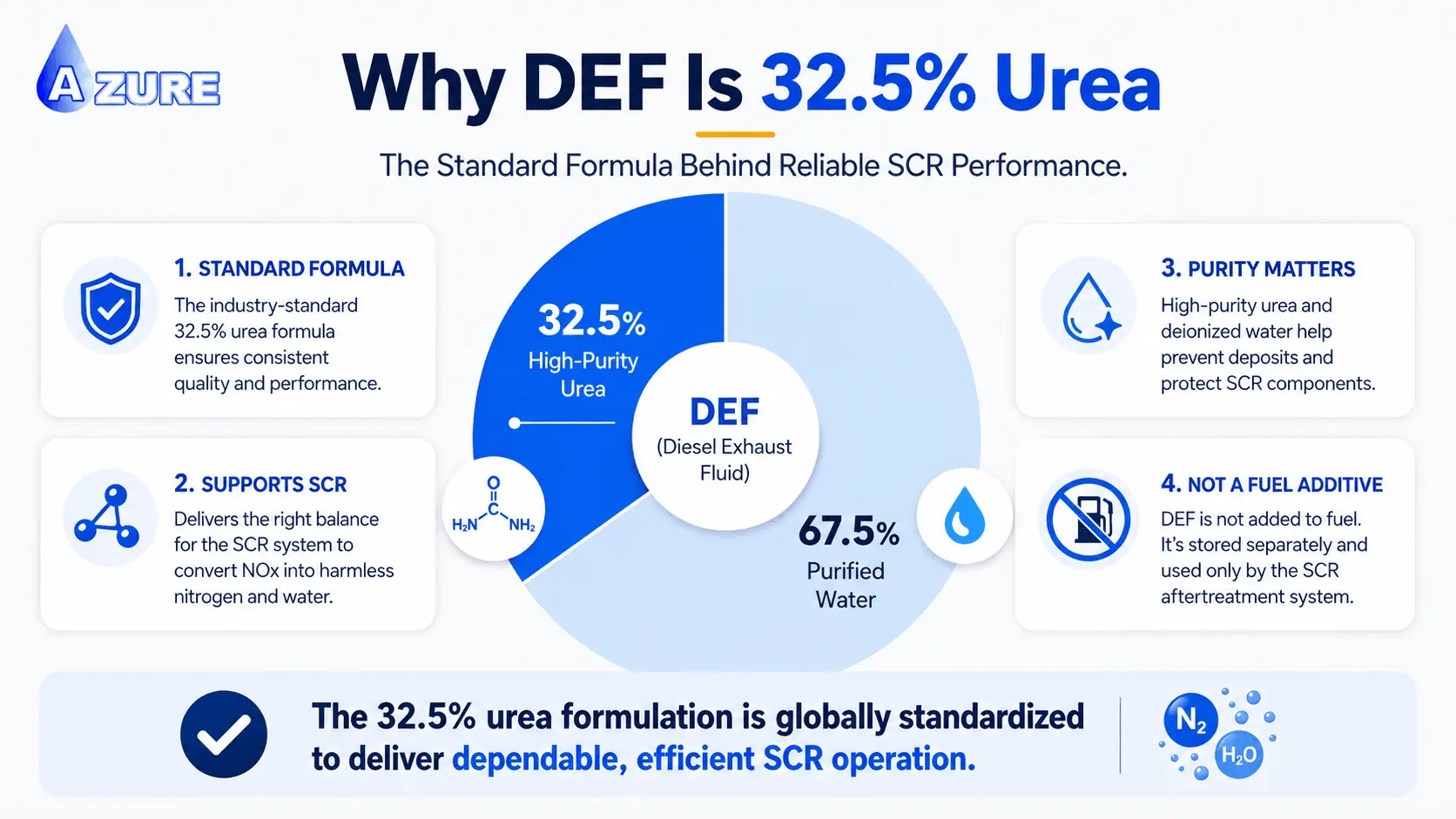
AUS 32 contains approximately:
| DEF Component | Concentration |
|---|---|
| Technically pure urea | 32.5% |
| Purified water | 67.5% |
The 32.5% formulation is standardized for use in automotive SCR systems. ISO 22241 defines quality characteristics for AUS 32, while API operates a certification program for DEF products that demonstrate compliance with applicable requirements.
Azure Chemical's DEF 32 solution page provides additional information about its automotive and commercial DEF 32 offering.
Can Regular Fertilizer Urea Be Used Instead of DEF?
No.
This is one of the most important practical distinctions for fleet owners, equipment operators, maintenance managers, and anyone purchasing DEF in volume.
Agricultural urea and DEF-grade urea are not interchangeable simply because both contain urea.
DEF requires technically pure urea and purified water with tightly controlled contaminant levels. API specifically warns that using agricultural-grade urea or untreated water can introduce contaminants and metals that may damage SCR components or interfere with emissions performance. API guidance on purchasing and handling DEF
That means a homemade urea-and-water mixture is not an appropriate substitute for DEF.
The concentration can appear correct while the fluid still fails important purity requirements.
Why DEF Quality Matters to the SCR System
The SCR system depends on more than having liquid in the DEF tank.
Contamination, incorrect urea concentration, poor storage, unsuitable transfer equipment, or degraded fluid can interfere with the system.
Contaminants Can Affect SCR Components
DEF touches pumps, lines, dosing equipment, injectors, sensors, and other parts of the aftertreatment system.
Contamination from inappropriate containers, transfer equipment, water, fuel, oil, dust, or incompatible materials can create problems even when the fluid still looks clear.
This is why fleets should treat DEF quality control more like fuel or lubricant quality management than like topping up windshield washer fluid.
Azure Chemical discusses several of these risks in its article about the causes of poor-quality Diesel Exhaust Fluid.
More Urea Is Not Better
An SCR system is designed around a specific DEF formulation.
Using a stronger homemade solution does not provide "extra cleaning power." An incorrect concentration can interfere with system calibration, freezing behavior, spray characteristics, deposit formation, and emissions-control performance.
Use the fluid specification recommended by the equipment or vehicle manufacturer.
Does Urea Improve Diesel Engine Performance?
Not in the way an engine additive or performance fuel does.
DEF does not increase the energy content of diesel fuel, and urea does not enter the cylinders to create additional horsepower.
There is, however, an important engineering relationship between SCR and engine efficiency.
Because SCR can address NOx downstream in the exhaust, engine manufacturers have more flexibility when calibrating combustion. Instead of relying entirely on in-cylinder strategies to control NOx, engineers can balance combustion efficiency with downstream emissions treatment.
This means SCR technology can support efficient diesel-engine design, but it would be misleading to say that pouring more DEF into the system directly increases horsepower or fuel economy.
The dosing rate is controlled by the vehicle.
What Happens If a Diesel Vehicle Runs Out of DEF?
The engine does not suddenly lose its physical ability to combust diesel simply because the DEF tank is empty.
The issue is emissions-system compliance.
SCR-equipped vehicles monitor DEF level and system operation. Depending on the manufacturer, application, calibration, and regulations, low or empty DEF can trigger warning messages followed by an engine-power or vehicle-speed inducement.
For example, Cummins documentation describes DEF-related warning stages in which very low fluid levels, incorrect DEF, or SCR problems can lead to reduced engine power.
The exact sequence varies, so owners should follow the operator's manual for their specific vehicle or equipment instead of assuming every diesel behaves identically.
Does Every Diesel Engine Use Urea?
No.
Older diesel engines and some applications do not use SCR and therefore do not require DEF.
The relevant question is not simply whether the engine burns diesel. It is whether the vehicle or equipment is equipped with an SCR aftertreatment system designed to use DEF.
Modern on-road trucks, commercial vehicles, construction machinery, and other diesel applications commonly use SCR, but requirements vary by model year, engine family, market, and emissions standard.
Fleet operators can also explore Azure Chemical's information about DEF and diesel urea in the trucking industry.
What Is the Difference Between Urea, DEF, and SCR?
These terms are related, but they do not mean the same thing.
Here are their main differences.
| Term | What It Is | Role |
|---|---|---|
| Urea | A nitrogen-containing compound | Ingredient used to generate ammonia |
| DEF / AUS 32 | 32.5% technically pure urea in purified water | Fluid delivered to the exhaust aftertreatment system |
| DEF tank | Separate vehicle reservoir | Stores DEF |
| DEF injector | Dosing component | Introduces DEF into the exhaust |
| Ammonia | Reactive compound generated from urea | Reacts with NOx |
| SCR | Selective Catalytic Reduction system | Uses ammonia and a catalyst to reduce NOx |
| NOx | Nitrogen oxide pollutants | Target emissions being reduced |
A useful way to remember the relationship is:
Urea is an ingredient → DEF carries the urea → the exhaust turns it into ammonia → SCR uses the ammonia to reduce NOx.
Common Misconceptions About Urea in Diesel Engines
"DEF Is a Fuel Additive"
False.
DEF is stored separately and injected into the exhaust aftertreatment system.
"Urea Is Injected Into the Engine Cylinders"
False.
In a conventional automotive SCR system, DEF is introduced downstream of combustion.
"DEF Is Made From Urine"
False.
Commercial DEF uses synthetically manufactured, technically pure urea that must meet strict quality requirements. DEF is not manufactured from human or animal urine. API describes DEF as technically pure urea dissolved in purified water.
"Any Urea Will Work"
False.
Fertilizer-grade urea can contain materials that are inappropriate for an SCR system. DEF should meet the specification required by the vehicle or equipment manufacturer.
"More DEF Means Lower Emissions"
Not necessarily.
SCR performance depends on accurate dosing. Excessive or insufficient dosing can both create problems. The electronic control system determines the appropriate quantity based on operating conditions.
Practical DEF Tips for Fleet and Equipment Operators
Understanding what urea does in a diesel engine is useful, but preventing DEF-related downtime requires good operating practices.
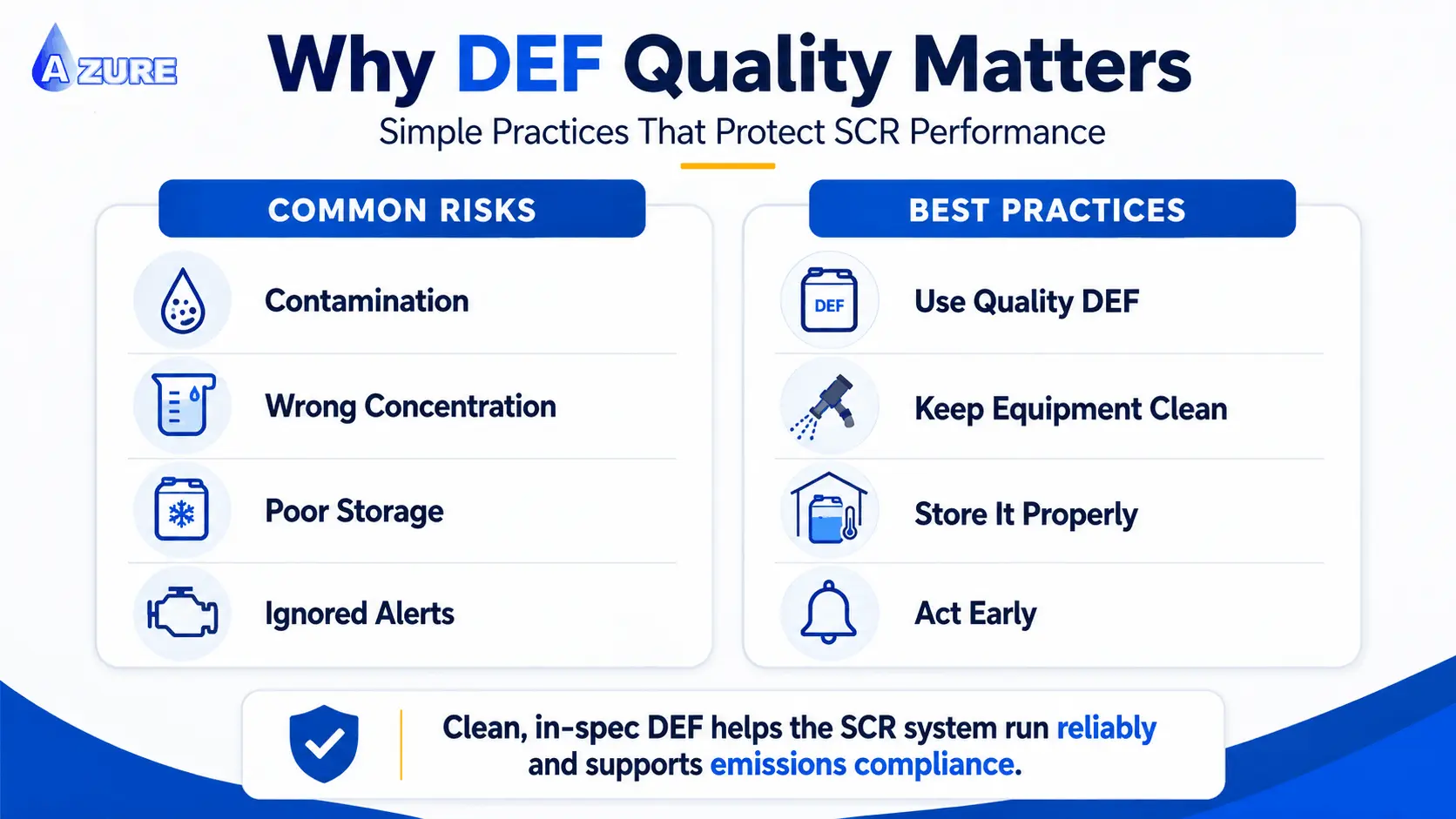
Buy DEF That Meets the Required Standard
Look for fluid that meets the applicable OEM and ISO requirements. API-certified DEF gives buyers an additional way to identify products participating in API's quality program.
Keep DEF Equipment Dedicated
Pumps, hoses, nozzles, funnels, and transfer equipment used for DEF should remain clean and dedicated to DEF whenever possible.
Cross-contamination with diesel fuel, oil, coolant, or other chemicals can compromise the fluid.
Keep Storage Containers Closed
DEF should be protected from dirt, dust, debris, and other sources of contamination.
Storage temperature also affects shelf life, so high-volume users should follow supplier and OEM recommendations for long-term storage.
Never Dilute DEF Yourself
Adding tap water or attempting to correct DEF concentration in the field can introduce contaminants or move the solution outside specification.
Respond to Warning Messages Early
A low DEF warning is easier to solve than an eventual derate.
Fleet maintenance programs should include DEF inventory, storage, dispensing, and vehicle-level monitoring rather than treating DEF as an emergency purchase.
Why Urea-Based SCR Became Important for Diesel Engines
Diesel engines have long been valued for durability, torque, and fuel efficiency, particularly in trucking, construction, agriculture, power generation, and heavy equipment.
The challenge is controlling pollutants while maintaining the characteristics that make diesel engines useful.
SCR addresses part of that challenge outside the engine.
Rather than requiring the combustion process alone to handle every emissions objective, the SCR system provides a dedicated method for reducing NOx after combustion.
That distinction is central to understanding modern diesel technology.
Urea does not make diesel fuel burn cleaner inside the cylinder. It enables a controlled chemical process in the exhaust that removes a significant portion of NOx before the exhaust reaches the atmosphere.
Frequently Asked Questions
What Does Urea Do in a Diesel Engine?
Urea is used as part of Diesel Exhaust Fluid in SCR-equipped diesel vehicles. DEF is injected into the exhaust, where urea is converted into ammonia. The ammonia then reacts with NOx in the SCR catalyst to produce primarily nitrogen and water.
Is Urea Mixed With Diesel Fuel?
No. DEF has a separate tank and must never be intentionally mixed with diesel fuel.
Is DEF the Same as Urea?
Not exactly. Urea is one ingredient in DEF. Automotive DEF or AUS 32 contains 32.5% technically pure urea and 67.5% purified water.
Why Is Urea Used Instead of Ammonia?
Urea provides a practical way to store and transport the chemical precursor needed to generate ammonia in the exhaust system. Directly storing ammonia onboard a vehicle would present very different handling and safety challenges.
Does Urea Remove Carbon Dioxide From Diesel Exhaust?
No. SCR primarily targets nitrogen oxides. It is not a carbon-capture system and should not be described as a technology for removing CO₂ from diesel exhaust.
Does DEF Reduce Diesel Particulate Matter?
SCR primarily controls NOx. Diesel particulate matter is generally addressed by other technologies, particularly diesel particulate filters, or DPFs.
Can Poor-Quality DEF Damage an SCR System?
Contaminated or off-specification DEF can interfere with SCR operation and may contribute to deposits, component problems, warning codes, or reduced emissions-system effectiveness. DEF quality and handling are therefore important.
How Much DEF Does a Diesel Engine Use?
Consumption depends on engine design, load, operating conditions, and duty cycle. It should not be assumed that every vehicle consumes DEF at the same percentage of diesel fuel. Cummins, for example, reports typical DEF consumption around 3% to 5% of diesel consumption for some applications, but the correct expectation should come from the specific engine manufacturer.
Can a Diesel Engine Run Without DEF?
A diesel engine can physically combust fuel without DEF, but an SCR-equipped vehicle is designed to operate with a functioning DEF system. Running low or empty can trigger warnings and, depending on the vehicle, eventual power or speed restrictions.
The Bottom Line: What Does Urea Do in a Diesel Engine?
So, what does urea do in a diesel engine?
It provides the chemical precursor that allows a Selective Catalytic Reduction system to reduce nitrogen oxide emissions.
Urea is delivered as part of DEF, injected into the exhaust rather than the fuel system, converted into ammonia by heat, and then used inside the SCR catalyst to transform NOx primarily into nitrogen and water.
For drivers, fleet managers, distributors, and equipment operators, the practical lesson is equally important: SCR performance depends not only on having DEF in the tank but on using correctly formulated, properly handled fluid.
Azure Chemical supplies high-quality DEF 32 for diesel applications along with DEF solutions for commercial fleets and industrial users. For bulk supply, delivery requirements, or product questions, contact Azure Chemical to discuss the needs of your operation.