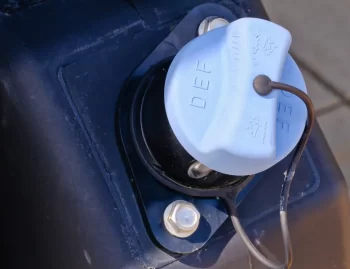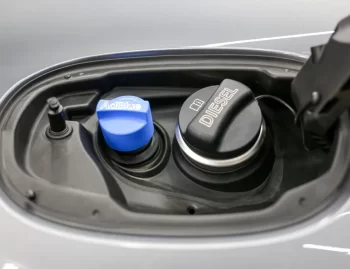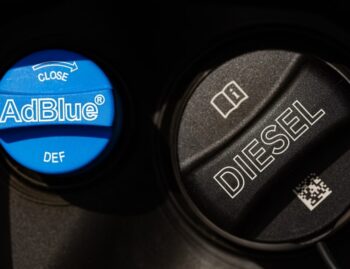
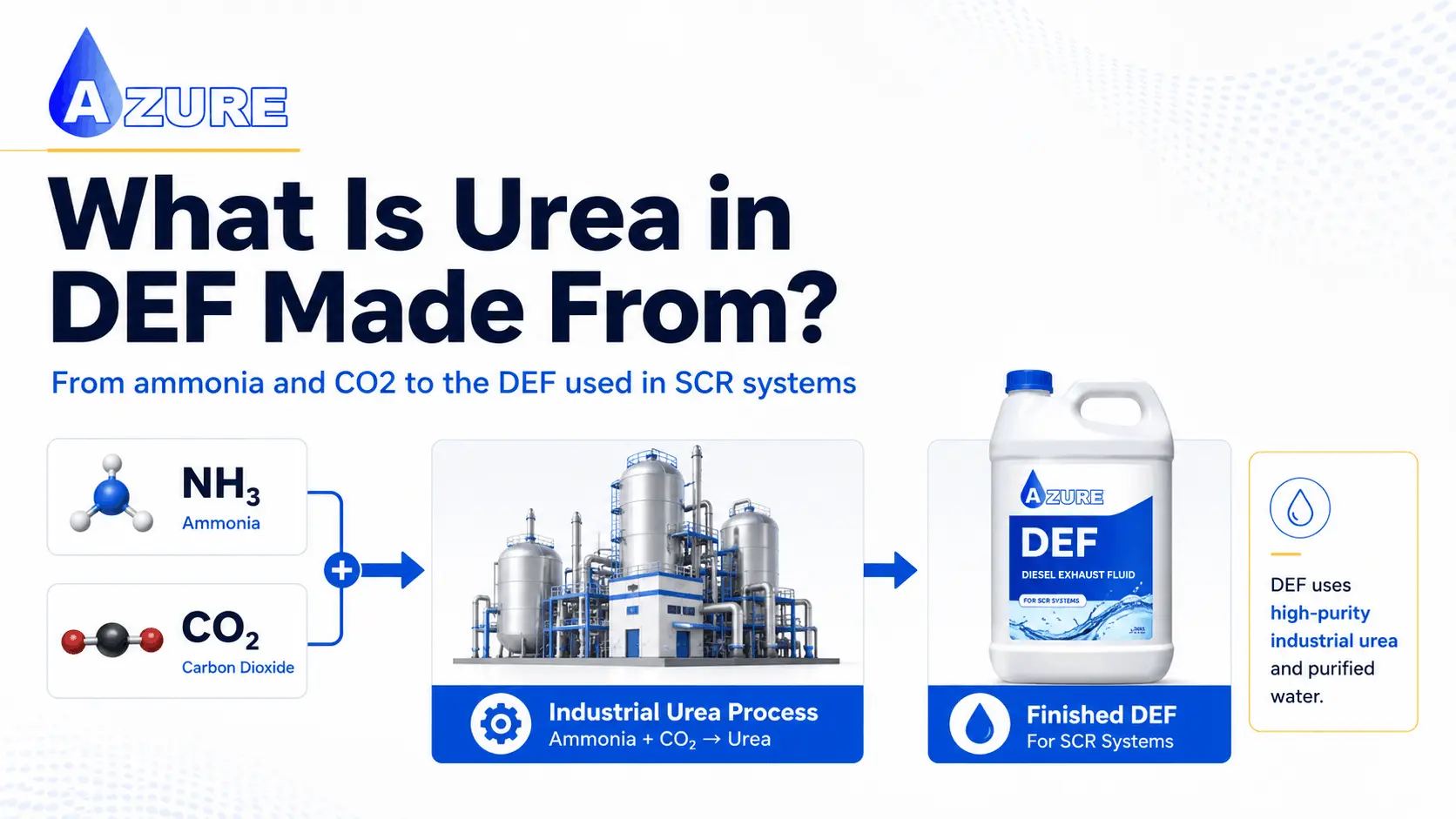
The urea used in Diesel Exhaust Fluid is industrially manufactured from ammonia and carbon dioxide.
Those raw materials are reacted under controlled industrial conditions to first create ammonium carbamate. That intermediate compound is then dehydrated to form urea and water. The resulting urea must be sufficiently purified and controlled before it is suitable for Diesel Exhaust Fluid.
The finished DEF itself is not pure urea. Standard automotive DEF, also known as AUS 32, contains:
| Component | Final DEF Composition |
|---|---|
| Technically pure urea | 32.5% by mass |
| Purified water | 67.5% by mass |
The International Organization for Standardization defines AUS 32 as a solution containing 32.5% technically pure urea in pure water for use as a NOx-reduction agent in Selective Catalytic Reduction systems.
For a broader explanation of the finished fluid, this guide by Azure Chemical will look into what is Urea in DEF made from.
Contents
- 1 What Raw Materials Are Used to Make DEF-Grade Urea?
- 2 How Is Urea for DEF Manufactured?
- 3 Is DEF Urea Synthetic?
- 4 What Makes Urea Suitable for DEF?
- 5 DEF-Grade Urea vs. Fertilizer Urea
- 6 How Does Urea Become Diesel Exhaust Fluid?
- 7 Why Is DEF 32.5% Urea?
- 8 What Happens to Urea After DEF Is Injected?
- 9 Why Urea Quality Can Affect SCR Reliability
- 10 Does the Source of the Ammonia Change the Urea Molecule?
- 11 Is Urea Production the Same as DEF Production?
- 12 A Better Way to Understand the DEF Supply Chain
- 13 Common Misconceptions About What Urea in DEF Is Made From
- 14 Frequently Asked Questions
- 14.1 What Is Urea in DEF Made From?
- 14.2 Is Urea Made From Natural Gas?
- 14.3 Is DEF Urea Made Using the Haber-Bosch Process?
- 14.4 Is Urea in DEF the Same Chemical as Fertilizer Urea?
- 14.5 Why Can't Fertilizer Urea Be Used to Make DEF?
- 14.6 Why Is DEF 32.5% Urea?
- 14.7 Is the Other 67.5% Just Tap Water?
- 14.8 Does DEF Urea Go Into the Diesel Fuel?
- 14.9 Is Urea Dangerous to an Engine?
- 15 The Bottom Line: What Is Urea in DEF Made From?
What Raw Materials Are Used to Make DEF-Grade Urea?
Urea looks chemically simple, but manufacturing a product suitable for sensitive diesel aftertreatment equipment requires controlled industrial chemistry.
The two primary feedstocks are:
Ammonia, NH₃
and
Carbon dioxide, CO₂
The EPA describes industrial urea production as reacting ammonia and carbon dioxide under elevated pressure and temperature. The first reaction forms ammonium carbamate, which is subsequently dehydrated to produce urea.
Where Does the Ammonia Come From?
Ammonia is itself manufactured industrially from nitrogen and hydrogen.
Traditional ammonia production commonly uses hydrogen derived from natural gas together with nitrogen separated from air. The Haber-Bosch process combines those gases under controlled temperature and pressure to produce ammonia.
This is where an important technical distinction needs to be made:
Haber-Bosch makes ammonia. It does not directly make urea.
The ammonia becomes one of the feedstocks used later in the separate urea-synthesis process.
That distinction was blurred in the previous version of Azure's article, and correcting it makes the content more technically reliable.
Where Does the Carbon Dioxide Come From?
Industrial urea plants need a concentrated CO₂ stream.
Historically, many urea plants have been integrated with ammonia plants because ammonia manufacturing can provide both the ammonia feedstock and a high-purity carbon dioxide stream used for urea synthesis. EPA manufacturing documentation describes this integration directly.
The chemistry is therefore more accurately visualized as:
Nitrogen + hydrogen → ammonia
then
Ammonia + CO₂ → urea
rather than describing the entire process as Haber-Bosch.
How Is Urea for DEF Manufactured?
Understanding what is urea in DEF made from becomes easier when the industrial reaction is separated into its two main chemical stages.
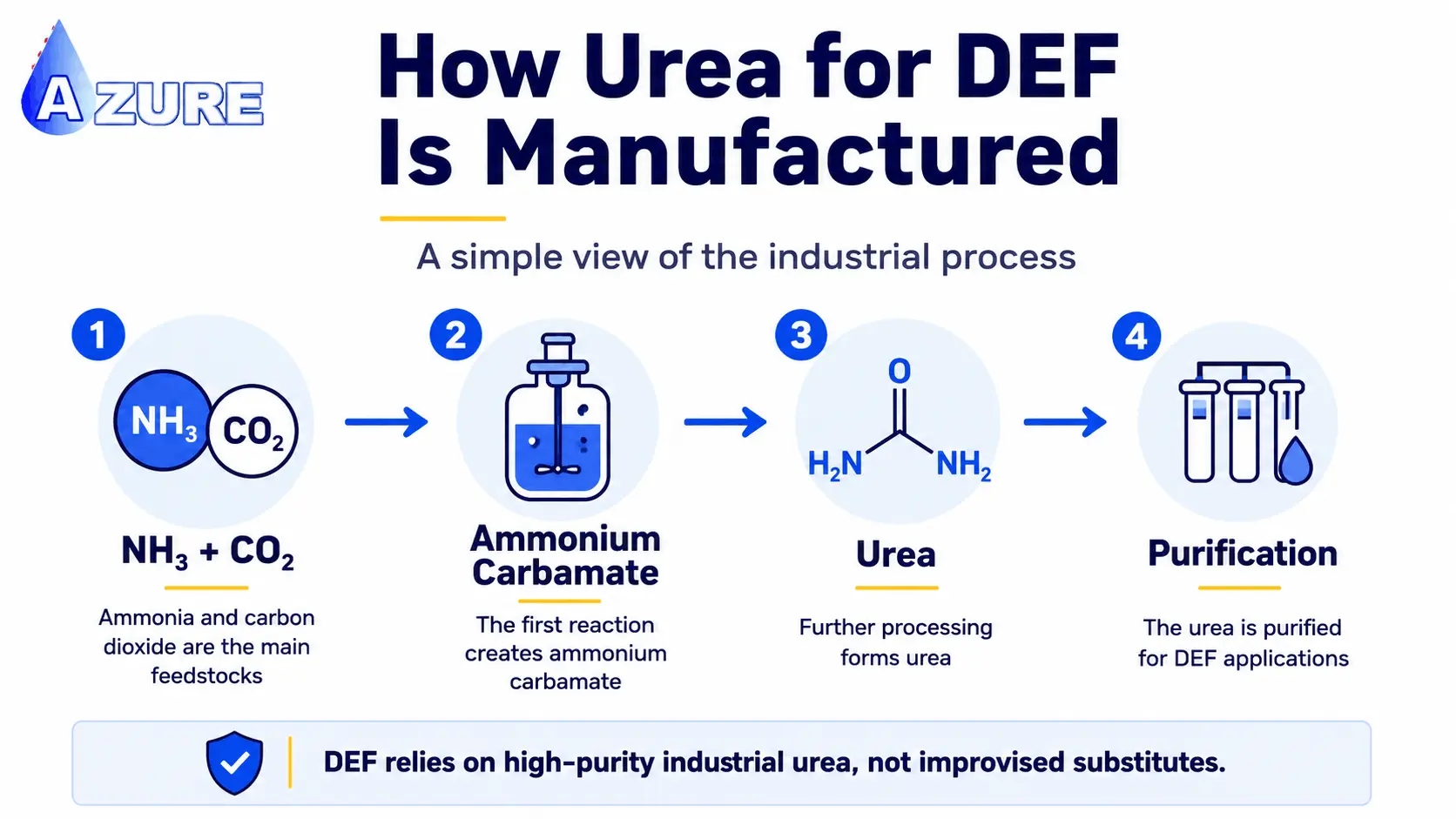
Step 1: Ammonia and Carbon Dioxide Form Ammonium Carbamate
The first major reaction is:
2NH₃ + CO₂ → NH₂COONH₄
Ammonia and carbon dioxide react under elevated pressure and temperature to form ammonium carbamate.
The EPA reports typical industrial solution-synthesis conditions in the neighborhood of 180°C to 200°C, although actual operating conditions vary by plant and technology.
Step 2: Ammonium Carbamate Becomes Urea
The ammonium carbamate is then dehydrated:
NH₂COONH₄ → CO(NH₂)₂ + H₂O
The product is urea plus water.
Not all ammonia and carbon dioxide convert in a single pass, so industrial facilities commonly recover and recycle unreacted material. Modern processes vary considerably in reactor design and recycling strategy, but the underlying chemistry remains the same.
Process At A Glance
Ammonia + CO₂ → Ammonium Carbamate → Urea → Purification/Quality Control → DEF Production
That is a much more accurate description of where the urea in DEF comes from.
Is DEF Urea Synthetic?
Yes, in the practical sense that the urea used for DEF is industrially synthesized rather than extracted from biological sources.
This is important because many drivers have heard that urea exists naturally in urine and assume that DEF therefore comes from animal or human waste.
It does not.
The chemical compound urea can exist in both biological and industrial contexts, but commercial DEF uses technically pure, industrially produced urea.
Azure addresses that misconception separately in its guide explaining whether DEF fluid is made from urine.
Keeping those two topics separate is useful for search intent:
What Makes Urea Suitable for DEF?
Manufacturing CO(NH₂)₂ is only part of the job.
A substance can chemically be urea and still be unsuitable for use in an SCR-equipped diesel vehicle.
This is where technical purity becomes critical.
ISO 22241 defines technically pure urea as an industrially produced grade of urea that is controlled for substances that could interfere with SCR systems. Its definition specifically excludes additives such as anticaking agents and contaminants such as sulfur compounds, chlorides, nitrates, and other unwanted substances.
Urea Concentration Is Not the Same as Urea Purity
This distinction is often misunderstood.
When someone says:
“DEF is 32.5% urea,”
that number describes the concentration of urea in the finished DEF solution.
It does not mean the raw urea ingredient is only 32.5% pure.
Likewise, agricultural urea is often described as 46% nitrogen. That figure represents its nitrogen content by mass. It does not mean the material is only 46% urea.
These are three different measurements:
| Term | What It Actually Describes |
|---|---|
| Urea purity | How free the urea feedstock is from unwanted substances |
| 32.5% | Urea concentration in finished automotive DEF |
| 46% nitrogen | Approximate elemental nitrogen content of chemically pure urea |
This distinction is especially important for procurement teams comparing agricultural urea with DEF-grade raw material.
DEF-Grade Urea vs. Fertilizer Urea
Urea molecules used in fertilizer and DEF are chemically the same compound.
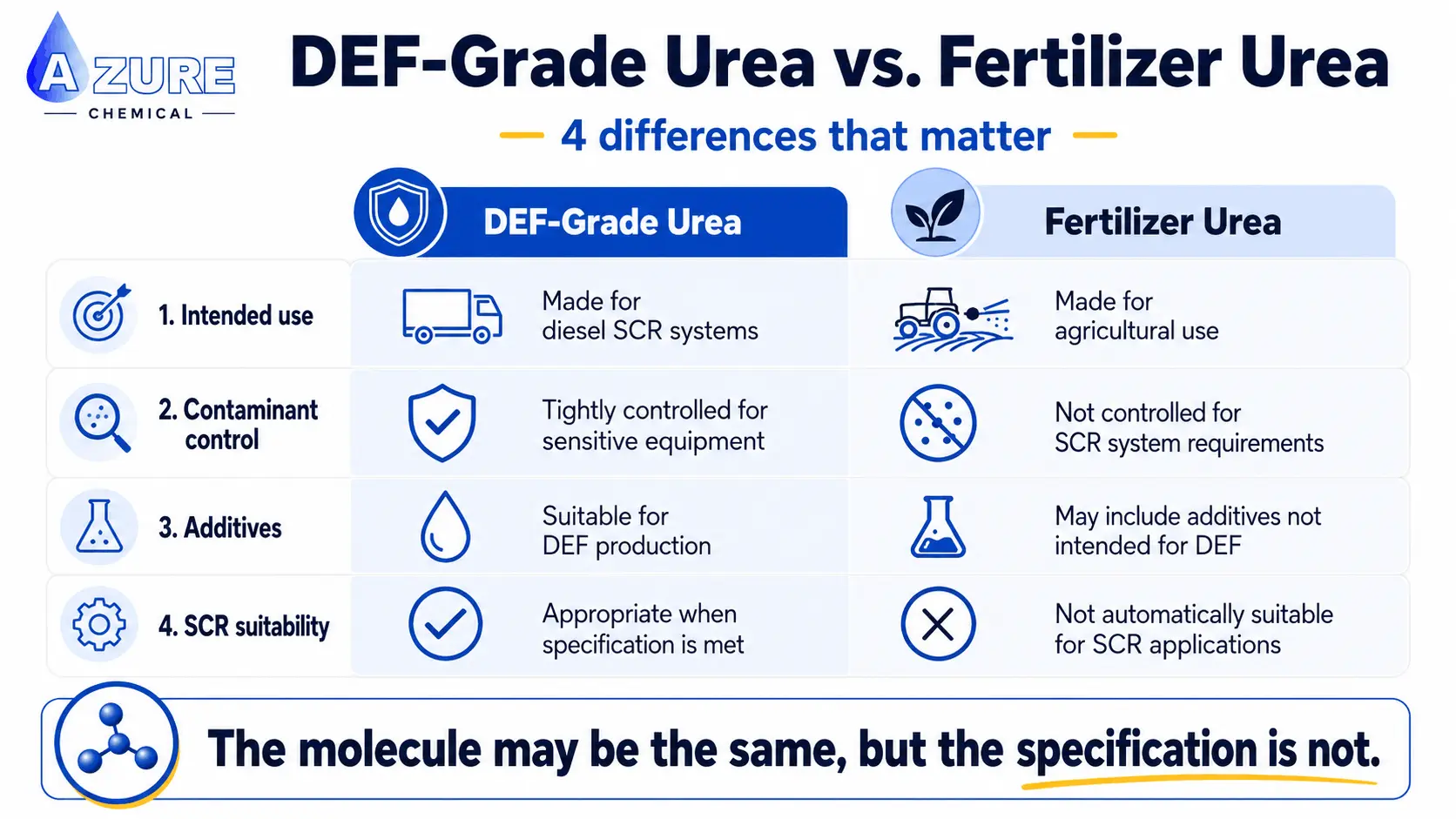
The difference is whether the material has been manufactured, handled, and documented to satisfy the requirements of its intended use.
| Characteristic | DEF-Grade Urea | Fertilizer-Grade Urea |
|---|---|---|
| Chemical compound | CO(NH₂)₂ | CO(NH₂)₂ |
| Intended use | SCR emissions systems | Plant nutrition |
| Contaminant control | Designed around DEF/SCR requirements | Designed around agricultural requirements |
| Anticaking agents | Must comply with DEF requirements | May be present depending on product |
| Final DEF suitability | Appropriate when specification is met | Cannot be assumed suitable |
| Required finished solution | 32.5% urea in purified water | Not applicable |
The American Petroleum Institute specifically warns that agricultural-grade urea can introduce contaminants that are detrimental to SCR-system life and emissions performance. API also notes that correct urea concentration alone does not prove a DEF product meets the full quality specification.
Azure discusses this issue in more depth in Can You Make Diesel Exhaust Fluid With Fertilizer Grade Urea?.
Why This Matters for Fleets
A fleet operator looking only at price may see agricultural urea and DEF urea as interchangeable commodities.
An SCR catalyst does not see them that way.
The aftertreatment system contains dosing equipment, pumps, sensors, injectors, catalyst materials, and fluid pathways designed around tightly controlled chemistry.
An unwanted contaminant at relatively low concentration can matter much more inside an emissions-control system than it would in an agricultural application.
How Does Urea Become Diesel Exhaust Fluid?
Once an appropriate technically pure urea feedstock is available, it is blended with sufficiently purified water to produce AUS 32.
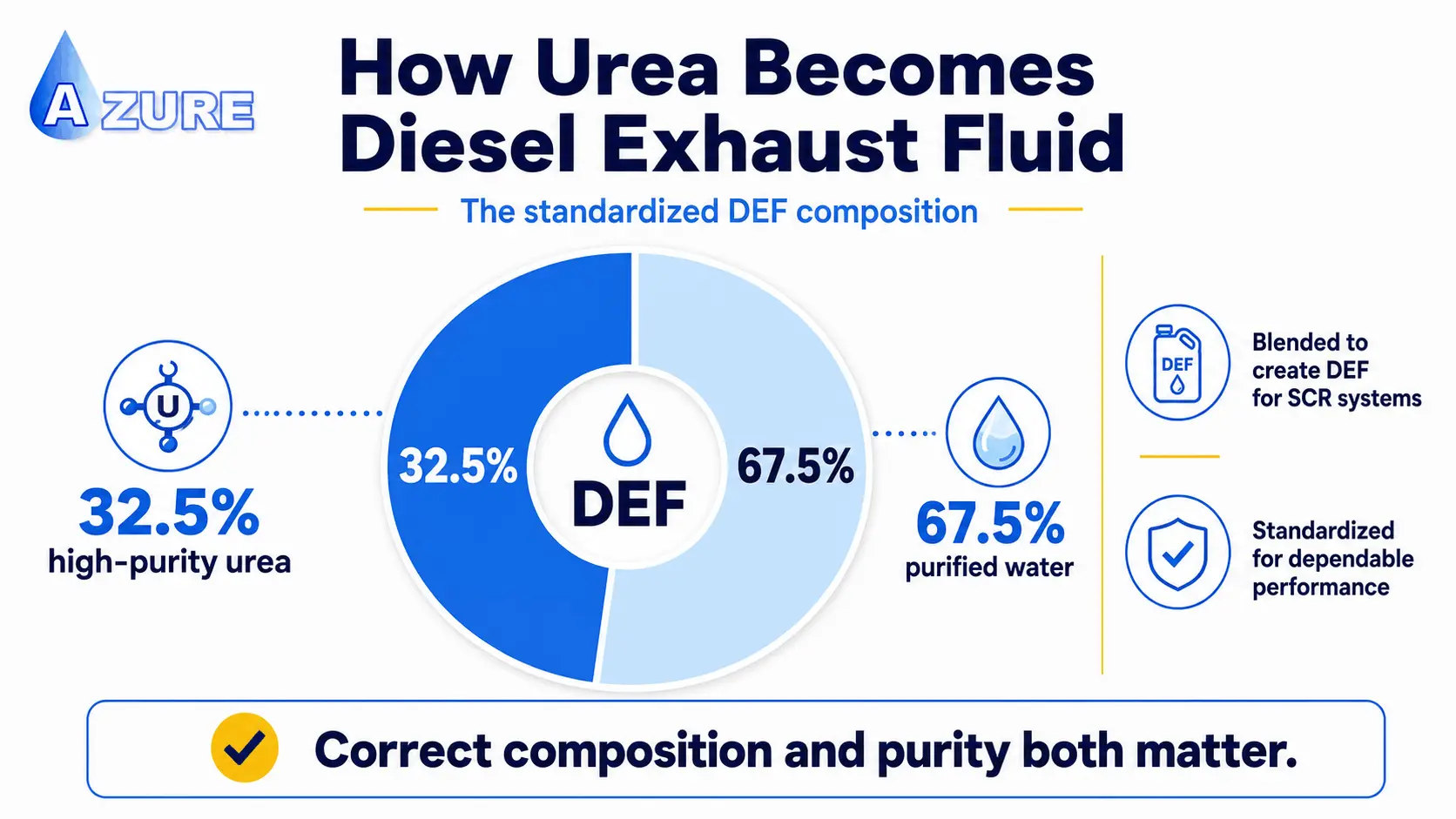
The target formulation is:
32.5% urea + 67.5% purified water
API describes the same standardized DEF formulation and emphasizes that both the quality of the urea and the quality of the water are essential.
Azure's dedicated guide to how Diesel Exhaust Fluid is manufactured covers the finished-fluid manufacturing process in more detail.
That article should remain the main destination for queries such as:
how is DEF made
while this page should primarily own:
what is urea in DEF made from
That separation reduces internal keyword cannibalization.
Why Is DEF 32.5% Urea?
The 32.5% concentration also has practical performance advantages.
According to Cummins DEF guidance for diesel applications, DEF at the standardized 32.5% urea concentration freezes at approximately 12°F (-11°C) and is designed to maintain its intended concentration through normal freeze-thaw cycles.
There is another important point:
SCR systems are engineered and calibrated around standardized DEF.
A homemade mixture that is "close enough" is not the same as specification-compliant DEF.
Concentration is only one variable. Contamination, water quality, handling, storage, and material compatibility also matter.
What Happens to Urea After DEF Is Injected?
The urea's manufacturing journey ultimately matters because of what happens inside the diesel exhaust aftertreatment system.
DEF does not enter the engine cylinders and does not mix with diesel fuel.
Instead, DEF is dosed into the exhaust.
DEF Enters the Hot Exhaust Stream
The vehicle's dosing system sprays a controlled quantity of DEF into the exhaust downstream of combustion.
Urea Generates Ammonia
Heat causes the urea to decompose through reactions that ultimately generate ammonia.
Ammonia Reaches the SCR Catalyst
That ammonia becomes the active reducing agent inside the Selective Catalytic Reduction system.
NOx Is Converted
The ammonia reacts with nitrogen oxides across the SCR catalyst, producing primarily nitrogen and water.
API describes SCR as an aftertreatment technology in which DEF, exhaust heat, and a catalyst convert NOx into nitrogen and water vapor.
Azure's guide to what urea does in a diesel engine focuses specifically on this downstream chemistry.
That article is a more natural destination for readers who want to understand urea's function, while this page focuses on its origin and manufacture.
Why Urea Quality Can Affect SCR Reliability
One useful way to think about DEF is that the SCR system does not simply need "urea."
It needs:
the correct urea + the correct water + the correct concentration + acceptable contaminant levels
That combination is what makes specification-compliant DEF.
Possible quality problems include contamination during manufacturing, unsuitable raw materials, poor water quality, cross-contamination during transfer, dirty storage equipment, evaporation during unsuitable storage, or introducing another chemical into the DEF supply.
API warns that improper urea or water can introduce metals and contaminants capable of shortening SCR-system life and impairing NOx reduction.
Azure's guide to the causes of poor-quality Diesel Exhaust Fluid covers downstream storage and contamination risks.
Does the Source of the Ammonia Change the Urea Molecule?
This is becoming a more relevant question as chemical producers investigate lower-carbon pathways for ammonia.
Chemically, urea remains CO(NH₂)₂ regardless of whether the hydrogen used to produce the upstream ammonia originated from conventional natural-gas reforming or another suitable production pathway.
For DEF applications, however, the key downstream issue is not simply the energy source used to make the ammonia.
The finished urea and DEF still need to meet the relevant quality requirements.
This distinction is useful when discussing "green ammonia," alternative hydrogen pathways, or lower-carbon urea production:
Feedstock pathway affects production footprint.
Chemical specification determines whether the resulting material is suitable for DEF.
Those are related but separate questions.
Is Urea Production the Same as DEF Production?
No.
They are different stages of the supply chain.
Urea production creates the chemical compound CO(NH₂)₂ from ammonia and carbon dioxide.
DEF production takes suitable technically pure urea and blends it with purified water at the standardized AUS 32 concentration.
DEF distribution then involves preserving that quality during storage, transportation, transfer, and dispensing.
This matters commercially because a product can leave a manufacturing facility within specification and later become contaminated through poor handling.
For fleet procurement, the supplier's storage, transfer equipment, tank management, and quality-control procedures therefore matter alongside the chemistry itself.
Azure's DEF 32 product page provides information about its DEF formulation, quality control, packaging, bulk delivery, and fleet supply options.
A Better Way to Understand the DEF Supply Chain
Instead of thinking of DEF as simply "urea and water," consider the full chain:
Air / hydrogen source
↓
Ammonia production
↓
Carbon dioxide + ammonia
↓
Ammonium carbamate
↓
Urea
↓
Quality-controlled technically pure urea
↓
Purified water + 32.5% urea
↓
AUS 32 / DEF
↓
Storage and distribution
↓
Vehicle DEF tank
↓
SCR exhaust treatment
Each stage has a different technical responsibility.
That broader view is especially useful for fleet operators, distributors, and bulk DEF buyers because it explains why DEF quality cannot be judged from concentration alone.
Common Misconceptions About What Urea in DEF Is Made From
“DEF Urea Comes From Urine”
No. Commercial DEF uses industrially produced technically pure urea.
“Haber-Bosch Makes DEF Urea”
Not directly. Haber-Bosch is used to manufacture ammonia. That ammonia then becomes a feedstock for a separate urea-synthesis process.
“Fertilizer Urea Is Automatically Suitable for DEF”
No. The underlying molecule may be the same, but DEF applications require appropriate contaminant control and finished-fluid quality.
“32.5% Means the Urea Is Only 32.5% Pure”
No. The 32.5% figure describes the proportion of urea in finished DEF.
“If the Concentration Is Correct, the DEF Is Good”
Not necessarily. The API guidance for purchasing, storing, and handling DEF warns that inappropriate urea, contaminated water, and poor handling practices can introduce substances that may harm SCR-system performance.
Frequently Asked Questions
What Is Urea in DEF Made From?
The urea used in DEF is industrially synthesized primarily from ammonia and carbon dioxide. These materials first form ammonium carbamate, which is then dehydrated to produce urea.
Is Urea Made From Natural Gas?
Not directly. Conventional ammonia production commonly derives hydrogen from natural gas, and that ammonia can then be reacted with carbon dioxide to produce urea. The immediate chemical feedstocks for urea synthesis are ammonia and CO₂.
Is DEF Urea Made Using the Haber-Bosch Process?
The ammonia used to manufacture urea may be produced using Haber-Bosch, but the urea itself is produced in a separate synthesis process involving ammonia and carbon dioxide.
Is Urea in DEF the Same Chemical as Fertilizer Urea?
Yes, the urea molecule is chemically CO(NH₂)₂ in both cases. The important difference is the material specification, contamination controls, additives, handling, and suitability for the intended application.
Why Can't Fertilizer Urea Be Used to Make DEF?
Fertilizer-grade material cannot automatically be assumed to meet the contaminant and purity requirements needed for SCR systems. API specifically cautions against using agricultural-grade urea as a substitute in DEF production.
Why Is DEF 32.5% Urea?
The standardized concentration is compatible with SCR-system design and provides favorable freeze-thaw behavior. At approximately 32.5%, DEF freezes around 12°F or -11°C.
Is the Other 67.5% Just Tap Water?
No. DEF requires purified water. Ordinary untreated tap water can contain dissolved minerals and metals that are inappropriate for the SCR system.
Does DEF Urea Go Into the Diesel Fuel?
No. DEF has a separate storage tank and is injected into the exhaust after combustion.
Is Urea Dangerous to an Engine?
Proper DEF stays in the exhaust aftertreatment system. Putting DEF into the diesel fuel system is contamination and can cause serious problems.
The Bottom Line: What Is Urea in DEF Made From?
So, what is urea in DEF made from?
The technically pure urea used in Diesel Exhaust Fluid begins with ammonia and carbon dioxide.
Those feedstocks undergo industrial urea synthesis:
Ammonia + CO₂ → ammonium carbamate → urea + water
The resulting urea must then meet stringent quality requirements before it is suitable for automotive DEF. It is blended with purified water so that the finished AUS 32 contains 32.5% technically pure urea and 67.5% purified water.
For fleet managers and bulk DEF buyers, the main takeaway is that urea chemistry is only the beginning of DEF quality. Raw-material purity, water quality, manufacturing control, storage, transfer equipment, and contamination prevention all influence whether the fluid reaching an SCR system performs as intended.
Azure Chemical supplies DEF 32 for commercial diesel applications in multiple packaging and bulk-delivery formats. For recurring fleet requirements, bulk orders, or distribution inquiries, contact Azure Chemical.